
How Conversational AI Checks Loan and Disbursement Status in Real Time and When It Still Hands Off to a Human
Insights / How Conversational AI Checks Loan and Disbursement Status in Real Time and When It Still Hands Off to a Human
Conversational Ai Loan Status India

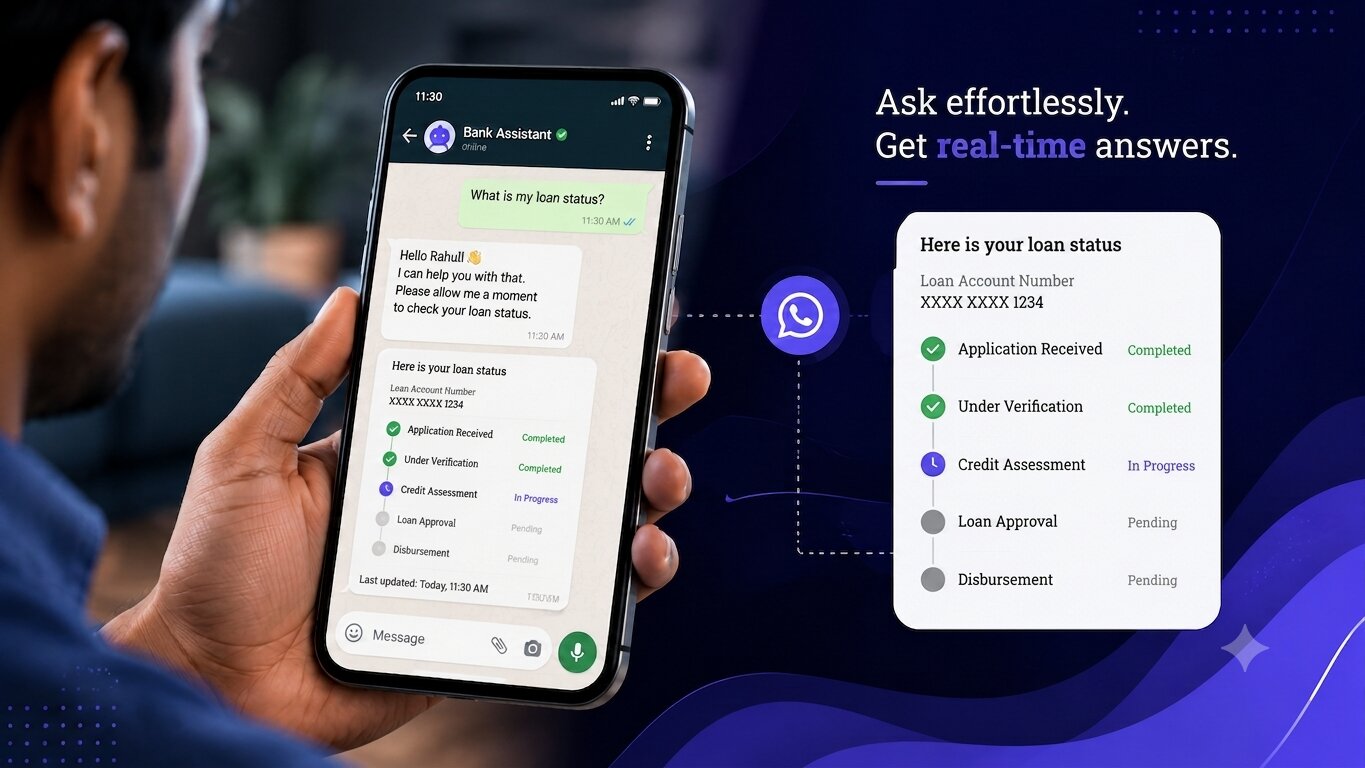
Lina has just completed her personal loan application. She uploaded her KYC documents in the afternoon and received an acknowledgement from the bank. By evening, she’s wondering whether her documents have been verified, if her loan has been approved and when the money will be credited to her account.

Instead of waiting until the contact centre opens or sitting through an IVR menu, she opens WhatsApp and asks a simple question: “What’s the status of my loan application?”

Within seconds, the bank’s conversational AI authenticates her identity, retrieves the latest information from its lending systems and explains exactly where her application stands. If additional documents are required, it tells her what’s missing. If the loan has been approved, it shares the next steps. And if the query needs human intervention, it transfers the conversation with the full context intact.

This is rapidly becoming the new standard for lending support. By combining conversational AI with live access to loan management and banking systems, banks and NBFCs can provide instant, accurate updates while reducing support volumes and improving the customer experience.

Why Loan Status Enquiries Dominate Support Volume

For most banks and Non-Banking Financial Companies (NBFCs), loan status updates are among the most frequent customer enquiries. Applicants naturally want to know where they stand; whether their documents have been verified, the loan has been approved, or the funds have been disbursed. Every stage of the lending journey creates another reason to check for an update.

The challenge is that these enquiries are repetitive, even though the answers already exist within the bank’s systems. Yet many organisations still rely on customers calling a contact centre, waiting in an IVR queue or speaking to an available agent for information that could be shared instantly.

Handling thousands of routine status requests manually increases operating costs, ties up support teams and slows response times. By automating these interactions, banks can free their agents to focus on complex cases that genuinely require human judgement.

How Conversational AI Retrieves Status in Real Time

Retrieving a loan status update isn’t about guessing or searching a knowledge base. A conversational AI assistant follows a secure, structured process to provide accurate information.

1. Authenticate the Customer

Before sharing any loan information, the assistant verifies the customer’s identity using an OTP, mobile number, customer ID or PAN.

2. Connect to Live Systems

Once authenticated, it retrieves the latest information from the Loan Management System (LMS), core banking platform, CRM, KYC platform, document management system and payment gateway.

3. Share the Current Status

The assistant returns the live status of the application—whether it’s under verification, awaiting additional documents, approved, scheduled for disbursement or already credited—along with any next steps the customer needs to take.

This approach ensures customers receive accurate, real-time updates while reducing the need for routine support enquiries.

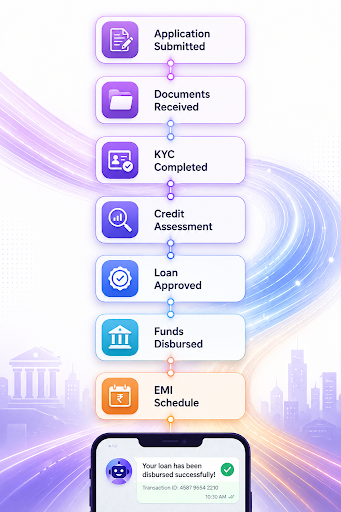
The Loan Journey a Customer Can Track

The illustration below shows a typical loan journey from application to repayment. At every stage, conversational AI can retrieve real-time updates from the bank’s systems, giving customers instant visibility into the progress of their application.

Conversational Ai for Loan Journey Tracking

Explaining Delays Instead of Saying “Under Process”

Generic updates like “Your request is under process” rarely answer a customer’s question. Instead, conversational AI can explain the exact stage of the application, whether documents are under review, employer verification is pending or additional information is required. By providing meaningful, real-time updates, banks reduce repeat enquiries while giving customers greater confidence in the lending process.

Support Across Every Channel, With Context That Carries Over

A customer might ask on WhatsApp in the morning, check the mobile banking app at lunch, and call in the evening. The conversation should read as one continuous thread across all of it — web chat, voice, the customer portal, wherever they show up — not three separate interactions that each start from zero.

When It Should Hand Off to a Person

Conversational AI can handle most routine loan status enquiries, but some situations require human judgement and intervention. These include:

Eligibility disputes — When applicants question a rejection or want a detailed explanation of a lending decision.

Fraud and identity concerns — Suspicious activity, unauthorised applications or account mismatches should be escalated immediately.

Manual underwriting — Complex business loans, high-value lending and mortgage exceptions often require specialist review.

Disputes and complaints — Incorrect disbursements, duplicate deductions and EMI-related issues need human ownership and resolution.

Customer preference — If a customer requests to speak to an advisor, the conversation should be transferred without unnecessary delays.

What Gets Passed to the Agent During Handoff

A clean handoff carries the customer’s identity, loan number, full conversation history, verified documents, current stage, prior interactions, likely intent, and priority level; so the receiving agent picks up the case already informed, rather than asking the customer to explain everything again from scratch.

What Banks and NBFCs Gain From This

For CustomersFor Lenders
24/7 access to loan informationReduced contact centre volume
Instant, real-time status updatesFaster query resolution
Less time spent waiting for supportLower operational costs
A smoother, more transparent lending experienceHigher customer satisfaction and improved scalability

Best Practices for Deploying This in Lending

When evaluating a conversational AI solution for lending, look for capabilities that support both customer experience and regulatory compliance:

Secure customer authentication before any loan information is shared.

Real-time integration with lending and core banking systems for accurate status updates.

Support for Hindi and other regional languages to improve accessibility.

Clear, contextual responses instead of generic status messages.

A unified conversation history across every customer touchpoint.

Intelligent handoff to human advisors for disputes, fraud and complex underwriting.

Continuous monitoring of response accuracy, customer satisfaction and operational performance.

Built-in support for DPDP Act requirements, including explicit consent, secure data handling and purpose-based access to customer information.

Conversational Ai Loan Status

How Worktual Supports This for Indian Lenders

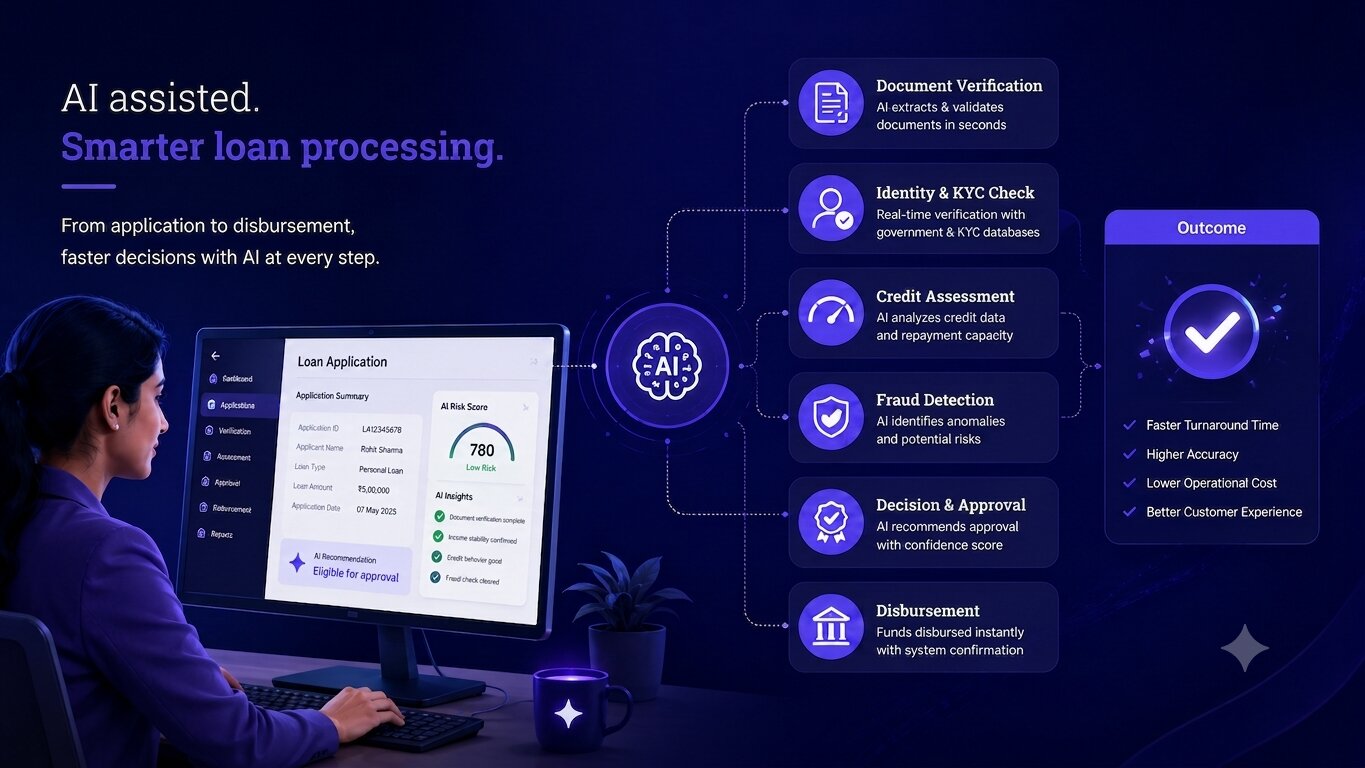
Worktual’s AI assistant, Lola, helps banks and NBFCs automate the entire loan enquiry journey; from secure customer authentication to real-time status retrieval. By integrating with loan management, core banking and KYC systems, it provides accurate, contextual updates instead of generic responses.

When a query requires human expertise, such as a dispute, fraud concern or underwriting exception, the conversation is seamlessly transferred with the full customer context intact. Whether the interaction begins on WhatsApp, the banking app, the website or a phone call, customers experience one continuous conversation while agents receive the complete history needed to resolve the issue efficiently.

Why this works better

The checklist reads like procurement guidance rather than a list of technical requirements.

The DPDP Act is naturally included under compliance instead of interrupting the flow.

The Worktual section focuses on outcomes first and features second.

The repetitive “not this, but that” construction has been removed while keeping the same meaning.

Conclusion

Loan status enquiries don’t need to overwhelm contact centres or frustrate customers. By combining conversational AI with live lending systems, banks and NBFCs can provide accurate, real-time updates while reducing routine support volumes and improving the overall customer experience.

The greatest value comes from knowing when to automate and when to involve a human. Organisations that strike this balance will be better positioned to deliver faster service, lower operating costs and a more transparent lending journey.

For Indian banks and NBFCs, getting that balance right is what actually builds trust, lowers support cost, and makes the lending experience feel faster and more transparent than it used to.

Looking to modernise your lending support? Worktual’s AI Contact Centre helps banks and NBFCs automate loan status enquiries, deliver seamless omnichannel experiences and empower agents with complete customer context.

Frequently Asked Questions

1. How does conversational AI check loan status in real time?

After authenticating the customer, the AI assistant retrieves live information from the Loan Management System, core banking platform and other connected systems. It then shares the current stage of the application, along with any relevant next steps.

2. Can conversational AI provide loan disbursement status instantly?

Yes. As soon as the disbursement is recorded in the bank’s systems, the assistant can confirm the transaction, share the status and, where available, provide the transaction reference.

3. Is customer authentication required before sharing loan information?

Absolutely. Customers must be authenticated using methods such as an OTP, customer ID or PAN before any loan details are disclosed, regardless of the channel they use.

4. Which channels can customers use to check their loan status?

Customers can check their loan status through WhatsApp, the mobile banking app, the website, voice support or a customer portal. With an omnichannel platform, the conversation and context remain consistent across every channel.

5. When does conversational AI transfer the conversation to a human agent?

The conversation is transferred when human expertise is required—for example, in cases involving eligibility disputes, fraud concerns, manual underwriting, complaints or whenever a customer requests to speak with an advisor.

Related Posts

Ai CRM vs Traditional CRM

AI-Native CRM vs Traditional CRM: What Actually Moves the Revenue Needle

Sales teams already know speed matters. Dr. James Oldroyd’s 2007 MIT/InsideSales.com study found that contacting a lead within 5 minutes makes a rep 100 times more likely to connect than waiting 30. Yet Harvard Business Review’s 2011 audit of 2,241 firms found the average business still takes 42 hours to respond. This isn’t a knowledge gap; it’s a knowing-doing gap. The real question isn’t whether speed matters. It’s which system actually closes that gap, rather than just reporting on it.

Ai CRM for Higher Education

AI CRM for Higher Education: The Complete Guide for Indian Institutions

An AI CRM for higher education is admissions software that scores, routes, and follows up with prospective students automatically, rather than requiring a counsellor to manually track every enquiry. India’s National Education Policy 2020 targets a 50% Gross Enrolment Ratio in higher education by 2035, up from 28.4% in 2021–22 — a scale of growth Indian institutions cannot manage with manual, spreadsheet-driven admissions processes.

AI-Native Cognitive Data Platform for Ecommerce

AI-Native Cognitive Customer Data Platforms for Ecommerce: Improving Customer Retention, Purchase Intelligence, and Customer Lifetime Value

Indias ecommerce industry continues to expand at a remarkable pace. Valued at approximately US$125 billion in 2024, the market is projected to reach US$345 billion by 2030, growing at a compound annual growth rate (CAGR) of 18.4% (IBEF). As businesses compete across marketplaces, quick commerce platforms, mobile applications, social commerce, and D2C channels, sustainable growth increasingly depends not only on acquiring new customers but also on increasing repeat purchases, strengthening customer loyalty, and maximising Customer Lifetime Value (CLV).