AI CRM for Higher Education: The Complete Guide for Indian Institutions

Insights / AI CRM for Higher Education: The Complete Guide for Indian Institutions

Ai CRM for Higher Education

An AI CRM for higher education is admissions software that scores, routes, and follows up with prospective students automatically, rather than requiring a counsellor to manually track every enquiry. India’s National Education Policy 2020 targets a 50% Gross Enrolment Ratio in higher education by 2035, up from 28.4% in 2021–22 a scale of growth Indian institutions cannot manage with manual, spreadsheet-driven admissions processes. This guide covers what an AI CRM actually does for admissions, what it costs institutions that don’t have one, and what to check before choosing a platform.

  • What Is an AI CRM for Higher Education?
  • Why Indian Higher Education Institutions Need AI CRM Now
  • Core Capabilities of an AI CRM for Admissions and Enrolment
  • How Much Can AI CRM Improve Enrolment Outcomes?
  • AI CRM vs Traditional CRM vs College ERP
  • DPDP Act Compliance and Data Governance
  • A Realistic Scenario
  • Choosing the Right AI CRM Partner for Your Institution
  • FAQs

What Is an AI CRM for Higher Education?

An AI CRM for higher education is software built specifically to manage the admissions funnel from first enquiry through enrolment using AI to score leads, automate follow-up, and route enquiries to the right counsellor. This is a different category from a college ERP or Student Information System (SIS), which manages already-enrolled students’ academic records. An AI CRM manages the funnel before that point: the enquiries, applications, and conversions an ERP was never built to handle.

Why Indian Higher Education Institutions Need AI CRM Now

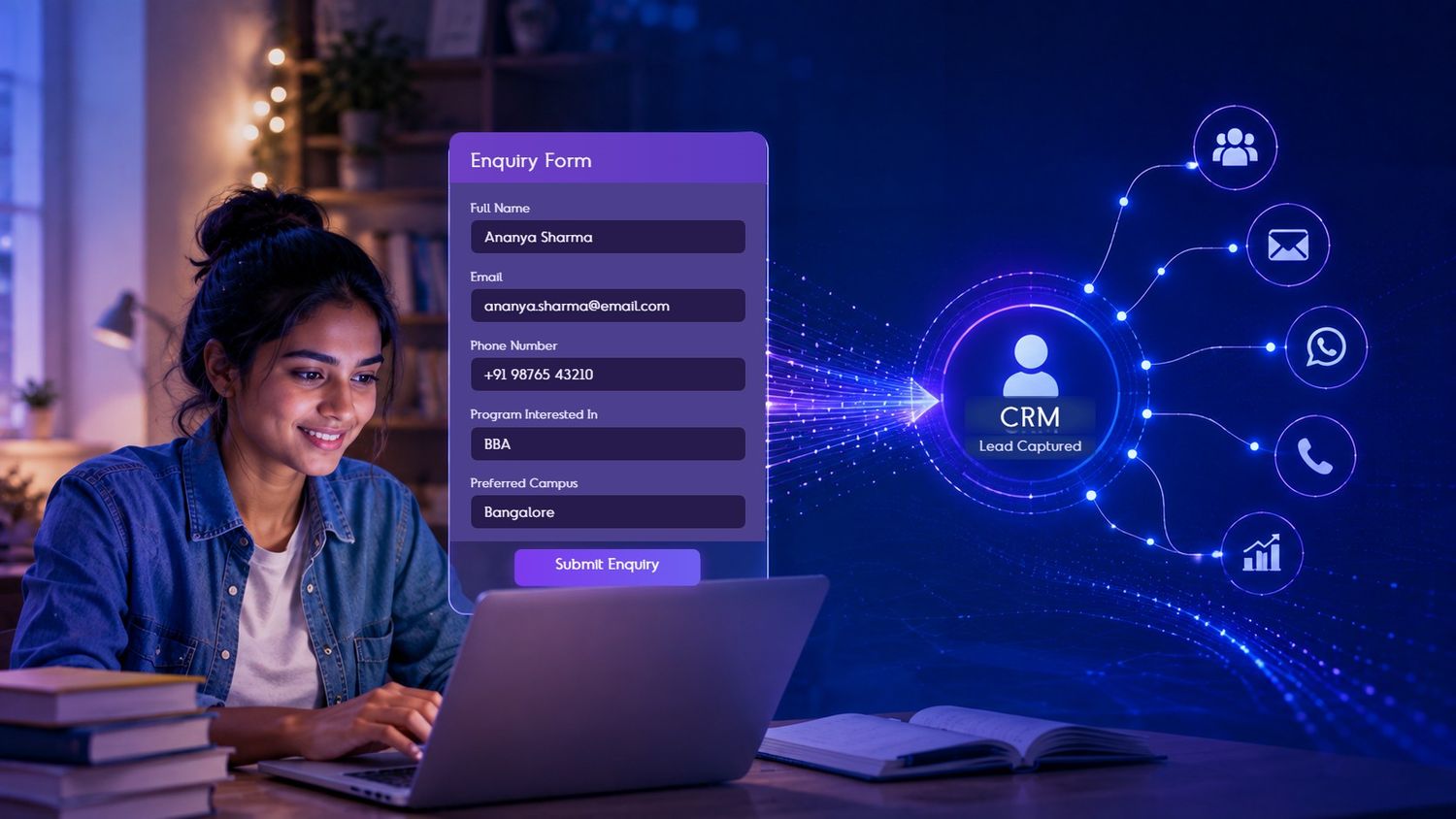
A prospective student fills out an enquiry form on a college’s website at 9 pm on a Saturday. In a manual process, that enquiry sits in an inbox until Monday, by which point the student has already enquired with three other institutions and forgotten which one replied first. With enquiry volumes rising and NEP 2020’s enrolment targets requiring institutions to reach far more prospective students than before, this gap between enquiry and response has become the single largest, most fixable source of lost admissions.

Core Capabilities of an AI CRM for Admissions and Enrolment

AI Lead Scoring and Prioritisation

Admissions-specific scoring looks different from generic sales scoring: program interest, application completeness, engagement with counsellor messages, and response speed all signal genuine intent, letting a counsellor work the most promising enquiries first rather than working through a list in the order it arrived.

Agentic AI: Calling, WhatsApp, and Auto-Qualification

AI calling agents and WhatsApp chatbots handle initial qualification around the clock confirming program interest, eligibility, and basic details before a human counsellor ever picks up the enquiry, so the counsellor’s first conversation is already informed, not a cold start

Counsellor Assist and Workload Reduction

Automated reminders, follow-up drafts, and application-status updates remove the repetitive part of a counsellor’s day, freeing time for the conversations that actually need a person, a genuine concern, a scholarship question, a parent’s hesitation.

Multi-Campus and Multi-Program Management

Role-based access and centralised visibility let a multi-campus institution see admissions performance across every location and program from one system, rather than reconciling separate spreadsheets from each campus at the end of every week.

Ai CRM for Educational Institution

How Much Can AI CRM Improve Enrolment Outcomes?

MetricTypical rangeWhy it moves
Enquiry response timeHours to minutesAutomated first response replaces manual triage
Counsellor productivityMeaningful uplift on routine follow-upsRepetitive scheduling and reminders automated
Conversion tracking accuracyHigher, consistentEvery touchpoint logged automatically, not manually

These are directional, industry-typical patterns, not guarantees for any specific institution; actual results depend heavily on enquiry volume, program mix, and how well the platform is actually adopted by counselling staff.

AI CRM vs Traditional CRM vs College ERP

DimensionCollege ERP/SISAI CRM
Core purposeManages enrolled student recordsManages and converts prospective students
FocusAcademic administrationAdmissions, enquiries, enrolment
Lead handlingNot applicableScoring, routing, follow-up
CommunicationLimited, internalWhatsApp, voice, email, all channels

A traditional CRM (without AI) still requires a counsellor to manually score and prioritise every enquiry; an AI CRM does this automatically. Neither replaces the ERP; the two systems serve different stages of the student lifecycle and typically work best integrated, not chosen as alternatives to each other.

DPDP Act Compliance and Data Governance

  • Explicit, purpose-limited consent for every prospective student’s data the DPDP Act has no legitimate-interest fallback.
  • Role-based access so only relevant staff can view a given applicant’s information.
  • Encryption and audit trails that can be shown to an institution’s own compliance review, not just claimed.
  • Clear data fiduciary and processor roles between the institution and the CRM vendor, confirmed directly rather than assumed.

A Realistic Scenario

A mid-sized private university was managing admissions enquiries across spreadsheets and individual counsellor phone logs, with no consistent way to see which enquiries had gone cold. After moving to an AI CRM, every enquiry from the website form, a WhatsApp message, or a phone call was captured, scored, and assigned automatically, with stale enquiries flagged for follow-up before they went cold rather than after. Counsellors spent less time on data entry and more time actually speaking with genuinely interested applicants, which is precisely where a person’s judgement is worth the most.

Choosing the Right AI CRM Partner for Your Institution

  • Is it DPDP-ready, with in-country data hosting confirmed directly?
  • Does it support WhatsApp and voice AI natively, not through a third-party bridge?
  • Can it handle multi-campus, multi-program structures without becoming unwieldy?
  • Does it integrate cleanly with your existing ERP or SIS?
  • Is pricing transparent and workable for your institution’s actual enquiry volume, not just a headline number?

Conclusion

India’s push toward a 50% Gross Enrolment Ratio by 2035 means institutions can’t keep managing admissions the way they did five years ago; manually, on spreadsheets, with enquiries going cold simply because nobody got to them in time. An AI-powered CRM closes that gap directly: enquiries are scored, routed, and followed up automatically, counsellors spend their time on the conversations that actually need judgement, and nothing falls through simply because a Saturday-night enquiry sat unanswered until Monday. The institutions that adopt AI-assisted admissions now, ahead of the enrolment growth NEP 2020 is driving, are the ones best placed to convert that growth into actual seats filled.

Book a Demo

FAQs

1. What is an AI CRM for higher education?

Software that manages the admissions funnel; enquiries, applications, and enrolment; using AI to score leads, automate follow-up, and route enquiries to the right counsellor automatically.

2. How does AI CRM improve student admissions in India?

By responding to enquiries within minutes instead of days, prioritising genuinely interested applicants, and ensuring no enquiry goes cold simply because nobody followed up in time.

3. What features should a higher education CRM in India have?

AI lead scoring, WhatsApp and voice AI, multi-campus support, DPDP-compliant data handling, and clean integration with your existing ERP or SIS.

4. Is education CRM software DPDP Act compliant?

It can be, provided the platform supports explicit consent capture, role-based access, and clearly defined data fiduciary and processor responsibilities worth confirming directly with any vendor.

5. How much can AI CRM increase enrolment conversion rates?

Institutions typically see meaningful gains from faster response times and reduced enquiry drop-off, though the exact figure depends heavily on enquiry volume and how well the platform is adopted by counselling staff.

6. What is the difference between a student CRM and a college ERP?

A CRM manages prospective students through the admissions funnel. An ERP or SIS manages already-enrolled students’ academic records. They serve different stages and typically work best integrated.

7. How does agentic AI work in student admissions?

AI agents handle initial qualification confirming program interest and eligibility via WhatsApp or a call before a human counsellor engages, so the first human conversation starts already informed.

8. Can an AI CRM handle WhatsApp and voice calls for admissions?

The strongest platforms handle both natively, since WhatsApp and phone remain the primary channels prospective students use to enquire in India.

9. How long does it take to implement an AI CRM for a university?

This varies by institution size and data complexity, but a focused single-campus rollout is typically faster than a full multi-campus, multi-program deployment.

10. What is lead scoring in an admissions CRM?

A method of ranking prospective students by likelihood to enrol, based on signals like program interest, engagement, and application completeness so counsellors work the most promising enquiries first.

11. Will AI replace admission counsellors?

No. AI handles repetitive qualification and follow-up; the counsellor’s role shifts toward the conversations that genuinely need judgement, not disappears.

12. How do multi-campus institutions manage admissions with one CRM?

Through role-based access and centralised dashboards that show performance across every campus and program from a single system, rather than reconciling separate spreadsheets.


Related Posts

AI-Native Cognitive Data Platform for Ecommerce

AI-Native Cognitive Customer Data Platforms for Ecommerce: Improving Customer Retention, Purchase Intelligence, and Customer Lifetime Value

Indias ecommerce industry continues to expand at a remarkable pace. Valued at approximately US$125 billion in 2024, the market is projected to reach US$345 billion by 2030, growing at a compound annual growth rate (CAGR) of 18.4% (IBEF). As businesses compete across marketplaces, quick commerce platforms, mobile applications, social commerce, and D2C channels, sustainable growth increasingly depends not only on acquiring new customers but also on increasing repeat purchases, strengthening customer loyalty, and maximising Customer Lifetime Value (CLV).
Ai CRM vs Traditional CRM

AI-Native CRM vs Traditional CRM: What Actually Moves the Revenue Needle

Sales teams already know speed matters. Dr. James Oldroyd’s 2007 MIT/InsideSales.com study found that contacting a lead within 5 minutes makes a rep 100 times more likely to connect than waiting 30. Yet Harvard Business Review’s 2011 audit of 2,241 firms found the average business still takes 42 hours to respond. This isn’t a knowledge gap; it’s a knowing-doing gap. The real question isn’t whether speed matters. It’s which system actually closes that gap, rather than just reporting on it.

Best Ai CRM India

Best AI CRM in India 2026: Top AI-Powered CRM Platforms Compared

In the food and beverage (F and B) sector, hospitality operators such as restaurants, pubs, and bars operate in a tightly managed commercial environment where revenue depends on converting demand into confirmed bookings, maximising spend per guest, and driving repeat visits over time. Covers, sitting time, menu mix, and return frequency all influence profitability, while rising labour costs and margin pressure leave little room for operational waste.