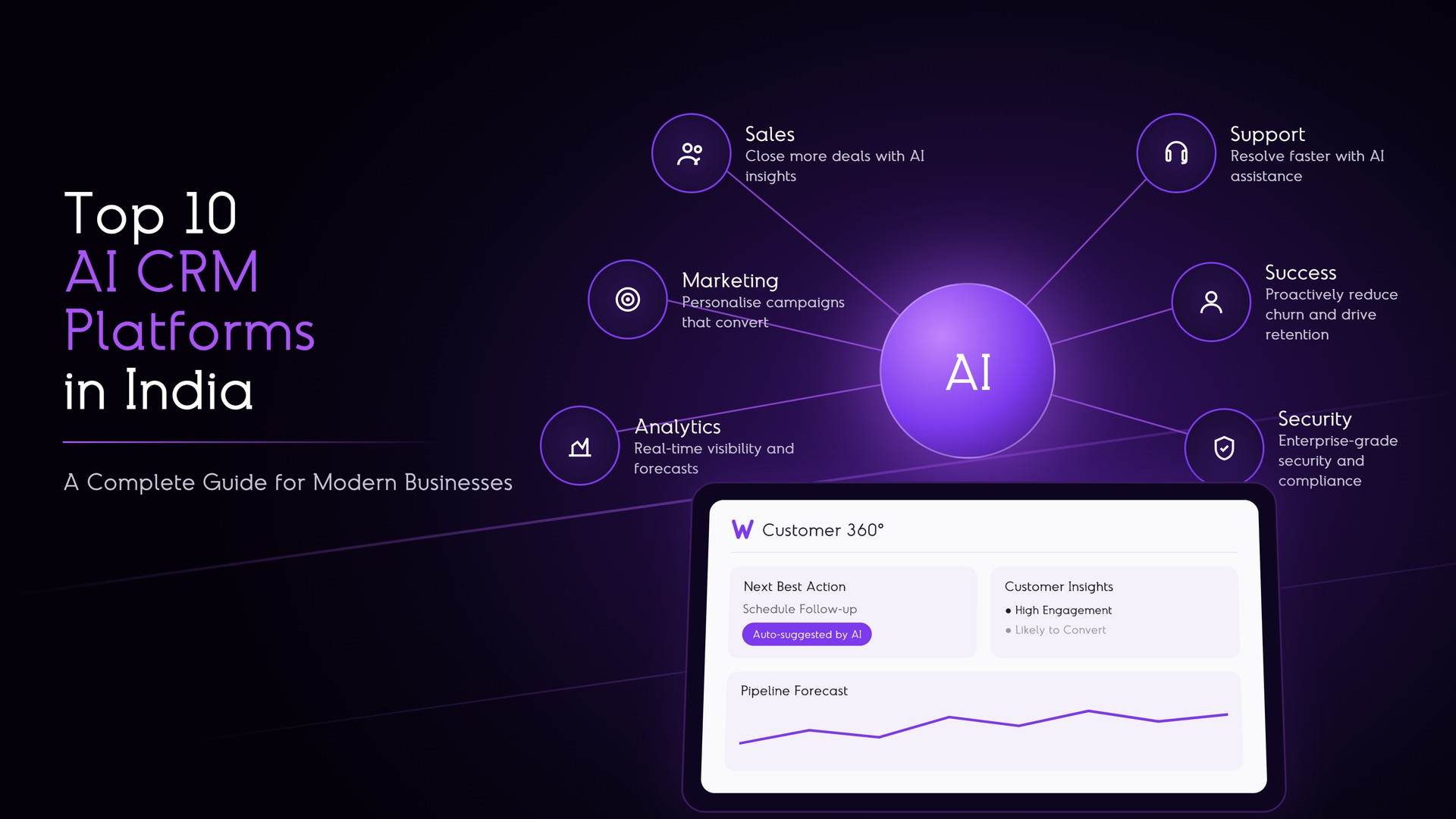
Best AI CRM in India 2026: Top AI-Powered CRM Platforms Compared

Insights / Best AI CRM in India 2026: Top AI-Powered CRM Platforms Compared

Best Ai CRM India

Introduction

AI is changing what businesses expect from customer relationship management. Today, organisations aren’t just looking for a CRM; they’re looking for an AI CRM or AI-powered CRM that can automate sales, improve customer engagement and reduce manual work.

Almost every CRM vendor now claims to offer AI, but not every platform delivers the same level of intelligence. Some add AI features to existing software, while others are designed with AI at their core. That difference affects automation, scalability and long-term business value.

This guide compares the leading AI CRM platforms in India, explains what separates a genuinely AI-powered CRM from one with AI add-ons, and highlights what businesses should consider before choosing a solution.

• What Makes a CRM Genuinely AI-Powered?

• Built-for-AI vs AI-Added: What’s the Difference

• Why Indian Businesses Are Adopting AI CRM in 2026

• Essential Features an AI CRM Should Offer

• Top 10 AI CRM Platforms in India

• Signs Your Business Needs an AI CRM

• How to Choose the Right AI CRM in India

• The Future of AI CRM in India

• Conclusion

What Makes a CRM Genuinely AI-Powered?

Not every AI CRM works in the same way.

Some platforms use AI to assist users by generating emails, summarising meetings or recommending the next best action. Others use AI to automate workflows, analyse customer behaviour and make decisions in real time.

Platforms in the second category are often described as AI-native because AI is built into the platform architecture rather than added as a feature. This allows AI to work across sales, marketing and customer service, continuously learning from customer interactions and helping teams act faster with less manual effort.

The distinction that matters isn’t whether a CRM includes AI—it’s how deeply AI is embedded into the platform.

Built-for-AI vs AI-Added: What's the Difference

Choosing an AI CRM isn’t just about the number of AI features it offers. The underlying architecture determines how effectively AI can automate work, learn from customer interactions and scale with your business.

Built for AIAI Added
AI is built into the platform architectureAI is added to an existing CRM platform
Automates workflows across the customer lifecyclePrimarily assists users with individual tasks
Uses predictive intelligence and continuous learningProvides AI suggestions based on available data
Delivers real-time recommendations and automationRelies more heavily on manual workflows
Easier to scale AI capabilities as business needs growAI capabilities often depend on additional modules or integrations
Continuously improves through ongoing customer interactionsAI functionality is typically limited to specific features

Why Indian Businesses Are Adopting AI CRM in 2026

Businesses are investing in AI CRM to improve productivity, deliver better customer experiences and grow revenue without increasing operational complexity.

Key drivers include:

• Rising customer expectations – Customers expect faster responses, personalised interactions and seamless engagement across WhatsApp, email, voice and other channels.

• Greater pressure on sales teams – AI helps prioritise leads, automate follow-ups and reduce the time spent on repetitive administrative tasks.

Improving operational efficiency – Automating routine sales, marketing and customer service activities allows teams to focus on higher-value work.

Digital transformation initiatives – As businesses modernise their operations, AI-powered CRM platforms are becoming a core part of their technology strategy.

Essential Features an AI CRM Should Offer

When evaluating an AI CRM, look beyond individual AI features. The platform should help automate customer engagement, improve decision-making and unify customer interactions.

Key capabilities include:

AI-powered sales automation, including lead scoring, opportunity prioritisation and predictive sales forecasting.

AI productivity tools, such as meeting summaries, email generation and follow-up recommendations.

Omnichannel customer engagement, with native support for WhatsApp Business, email, voice, live chat and social messaging.

Conversational AI, including AI chatbots, voice agents and multilingual customer interactions.

Workflow automation and unified customer intelligence, bringing together customer data, journeys and business processes in one platform.

Enterprise-grade security and compliance, with governance, role-based access and support for India’s DPDP Act requirements.

How AI CRM Improves Every Department

DepartmentHow AI CRM Creates Value
SalesPrioritises high-value leads, predicts deal outcomes, automates follow-ups and helps sales teams focus on opportunities most likely to convert.
MarketingSegments customers intelligently, personalises campaigns and optimises engagement based on customer behaviour and predicted intent.
Customer SupportAutomates routine enquiries, summarises conversations, routes cases intelligently and helps agents resolve issues faster.
Customer SuccessIdentifies churn risks, monitors account health and recommends proactive actions to improve retention and renewals.
LeadershipProvides real-time visibility into pipeline health, revenue forecasts and customer trends to support faster business decisions.

Top 10 AI CRM Platforms in India

No single AI CRM is the best fit for every business. The right choice depends on your organisation’s size, industry, existing technology stack, budget and AI requirements.

The platforms below represent some of the leading AI CRM solutions available in India today, each with different strengths depending on your business priorities

1. Worktual — Best for Mid-Market & Enterprises

Strengths

AI-powered CRM built around Worktual‘s Cognitive CDP, creating a unified customer view across WhatsApp, web, voice and email.

AI automates customer engagement, workflow orchestration and next-best actions rather than simply assisting users.

Lola, the built-in AI assistant, helps users interact with the CRM naturally while supporting onboarding and day-to-day productivity.

Single-platform approach combining CRM, customer engagement, AI agents and customer intelligence.

Considerations

Newer platform than long-established global CRM vendors, with a smaller ecosystem of third-party integrations.

2. Salesforce (Einstein / Agentforce) — Best for Large Enterprises

Strengths

One of the most comprehensive enterprise CRM platforms with advanced AI capabilities through Agentforce.

Extensive AppExchange ecosystem supporting thousands of third-party integrations.

Highly configurable platform suitable for large organisations with complex sales and service processes.

Considerations

Higher implementation costs and longer deployment timelines than many competitors.

Often requires certified implementation partners and dedicated CRM administration.

3. Microsoft Dynamics 365 — Best for Microsoft Ecosystems

Strengths

Deep integration with Microsoft 365, Teams, Outlook, Azure and the Power Platform.

Copilot enhances productivity across sales, customer service and business applications.

Strong choice for organisations already invested in the Microsoft ecosystem.

Considerations

Different business functions are licensed as separate modules, increasing complexity and cost.

AI capabilities continue to evolve but remain distributed across multiple Microsoft products.

4. Zoho CRM — Best for Growing SMBs

Strengths

Affordable pricing with a broad range of CRM, marketing and business applications.

Zia AI supports lead scoring, forecasting and sales insights.

Strong local presence with INR pricing and India-based support.

• Considerations

AI capabilities focus more on assistance than end-to-end workflow automation.

Large product ecosystem can increase implementation and administration complexity.

5. HubSpot — Best for Marketing-Led Growth

Strengths

Excellent marketing automation and inbound lead management.

Easy to learn and adopt for growing businesses.

Breeze AI improves content creation, sales productivity and customer engagement.

Considerations

Advanced automation and reporting require higher-tier plans.

Better suited to marketing-led organisations than highly customised enterprise sales environments.

6. LeadSquared — Best for High-Volume Lead Management

Strengths

Designed for industries such as education, BFSI and healthcare with large enquiry volumes.

Strong mobile capabilities for inside sales and field sales teams.

Industry-specific workflows reduce implementation effort.

Considerations

Less flexible as a general-purpose enterprise CRM outside its core industries.

7. Freshsales (Freshworks) — Best for Fast-Growing Businesses

Strengths

Modern interface with quick implementation and strong usability.

Freddy AI supports lead scoring, sales insights and productivity.

Native telephony and strong customer engagement capabilities.

Considerations

Workflow automation is less extensive than platforms built around AI-first automation.

Smaller ecosystem than Salesforce or Zoho.

8. Creatio — Best for Process Automation

Strengths

Powerful no-code platform for building business workflows.

Combines CRM with enterprise process automation.

Well suited to organisations with complex operational processes.

Considerations

Licensing can become expensive as additional CRM modules are added.

Greater flexibility comes with a steeper learning curve.

9. Pipedrive — Best for Sales Teams

Strengths

• Clean, intuitive pipeline management with fast user adoption.

• Quick implementation and minimal administration.

• Strong fit for small and medium-sized sales teams.

Considerations

• Limited marketing and customer service capabilities.

• Businesses often outgrow the platform as customer engagement requirements expand.

10. Groweon — Best for Budget-Conscious SMBs

Strengths

• Built with WhatsApp at the centre of customer engagement.

• AI supports lead scoring, follow-up recommendations and messaging.

• Affordable pricing for small Indian businesses.

Considerations

 Newer platform with a smaller customer base than more established CRM vendors.

• Broader marketing, analytics and enterprise capabilities are still evolving.

Ai CRM India

Signs Your Business Needs an AI CRM

If any of the following sound familiar, it may be time to move beyond a traditional CRM:

Your sales team spends more time updating the CRM than engaging with customers.

Customer conversations are scattered across WhatsApp, email, phone and other channels, making it difficult to maintain a complete customer view.

Follow-ups depend on manual reminders, leading to missed opportunities and inconsistent customer engagement.

Forecasts rely on historical reports rather than real-time insights and predictive intelligence.

Your CRM requires multiple third-party AI tools to automate everyday tasks.

User adoption is low because the platform feels complex or adds to administrative work.

Sales, marketing and customer service teams work from different customer data, creating disconnected experiences.

How to Choose the Right AI CRM in India

Choosing an AI CRM isn’t just about comparing features. The right platform should support your business today while providing the flexibility to scale as customer expectations and AI capabilities evolve.

When evaluating an AI CRM, consider the following:

• AI capabilities – Does the platform simply assist users, or can it automate workflows, provide predictive insights and support intelligent decision-making?

• Scalability – Can it grow with your business across sales, marketing and customer service without requiring multiple disconnected tools?

• Customer engagement – Does it support omnichannel communication, including WhatsApp, email, voice and other channels your customers use?

• Implementation and usability – How quickly can teams adopt the platform, and how much ongoing administration does it require?

• Security and compliance – Does it provide enterprise-grade security, governance and support for India’s DPDP Act requirements?

• Pricing and total cost of ownership – Consider implementation, licensing, training, integrations and ongoing support—not just the subscription price.

The Future of AI CRM in India

AI is changing CRM from a system that records customer interactions to one that actively helps businesses engage, sell and serve more effectively.

The next generation of AI-powered CRM platforms will increasingly:

Automate routine work across sales, marketing and customer service.

Use AI agents to handle customer conversations, qualify leads and assist employees.

Deliver predictive customer intelligence by identifying opportunities, risks and next-best actions in real time.

Create unified customer experiences by bringing together conversations, transactions and customer history across every channel.

Conclusion

Choosing the right AI CRM is about more than comparing features. The best platforms help businesses automate workflows, improve customer engagement and make better decisions using AI.

As AI becomes central to sales, marketing and customer service, businesses should look beyond individual AI features and evaluate how effectively a CRM can automate work, unify customer data and scale with future needs.

FAQs

1. What is an AI CRM?

An AI CRM uses artificial intelligence to automate tasks, analyse customer data and help sales, marketing and customer service teams work more efficiently.

2. How is an AI CRM different from a traditional CRM?

A traditional CRM stores customer data. An AI CRM also automates workflows, predicts outcomes and recommends or takes the next best action.

3. Which is the best AI CRM in India?

The best AI CRM depends on your business size, industry and requirements. Worktual, Salesforce, Microsoft Dynamics 365, Zoho CRM and HubSpot are among the leading options.

4. Why are businesses adopting AI CRM?

Businesses use AI CRM to automate repetitive work, improve customer engagement, increase productivity and make faster, data-driven decisions.

5. Can AI CRM automate customer engagement?

Yes. AI CRM can automate lead scoring, follow-ups, meeting summaries, customer support, ticket routing and personalised customer interactions.

6. Does AI CRM support WhatsApp Business?

Many AI CRM platforms offer native WhatsApp Business integration, making it easier to manage customer conversations alongside email, voice and other channels.

7. Is AI CRM suitable for SMEs?

Yes. AI CRM helps small and medium-sized businesses improve productivity, automate routine work and scale customer engagement without increasing team size.

8. What should I look for when choosing an AI CRM?

Look for strong AI capabilities, workflow automation, omnichannel engagement, scalability, security and ease of use.