AI-Native CRM vs Traditional CRM: What Actually Moves the Revenue Needle

Insights / AI-Native CRM vs Traditional CRM: What Actually Moves the Revenue Needle

Ai CRM vs Traditional CRM

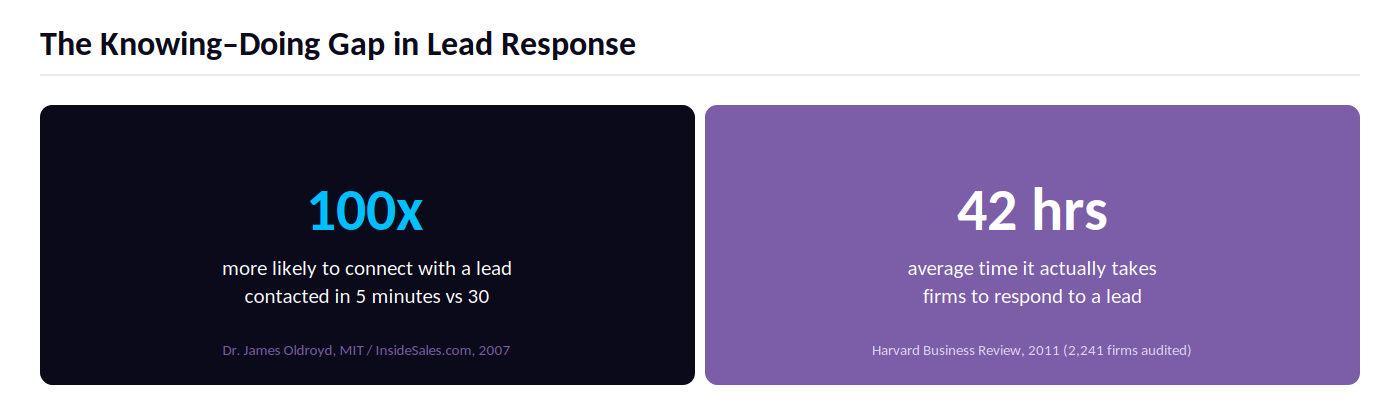
Sales teams already know speed matters. Dr. James Oldroyd’s 2007 MIT/InsideSales.com study found that contacting a lead within 5 minutes makes a rep 100 times more likely to connect than waiting 30. Yet Harvard Business Review’s 2011 audit of 2,241 firms found the average business still takes 42 hours to respond. This isn’t a knowledge gap; it’s a knowing-doing gap. The real question isn’t whether speed matters. It’s which system actually closes that gap, rather than just reporting on it.

Ai CRM vs Traditional CRM in India
  • Quick Definitions
  • Where Revenue Actually Leaks
  • How AI-Native CRM Closes Each Gap
  • Feature-by-Feature Comparison
  • Where AI-Native CRM Does NOT Move the Needle
  • AI-Native vs “AI-Added”
  • A Simple Framework to Decide
  • Where This Applies in India
  • FAQs

Quick Definitions

  • Traditional CRM — a system of record. It stores data; a person decides what to do with it.
  • AI-native CRM — a system of action. It acts on data in real time, rather than only storing it.

Many sales teams already suspect their CRM isn’t capturing the full picture; deals discussed over calls, WhatsApp, or email that never make it into a logged field. That’s a sign the record itself is incomplete, not just outdated.

Where Revenue Actually Leaks

  • Lead response lag — the 100x stat above isn’t theoretical; it’s the gap between a lead landing and a rep actually calling.
  • Silent pipeline decay — deals go quiet and nobody notices until the quarter-end review, because nothing is watching engagement in between.
  • Inconsistent follow-up — it depends entirely on whether a specific rep remembers to chase, not on a system that ensures it happens.
  • Forecast blind spots — forecasts are built on what a rep self-reports as the deal stage, not on what the buyer is actually doing.

How AI-Native CRM Closes Each Gap

  • Lead response lag → leads are scored and routed the instant they arrive, not queued for manual triage.
  • Silent pipeline decay → a deal’s engagement is tracked automatically, and flagged the moment it goes quiet against its own baseline.
  • Inconsistent follow-up → follow-up triggers automatically when a deal stalls, rather than depending on one rep’s memory.
  • Forecast blind spots → forecasts are built on actual buyer behaviour and engagement, not self-reported stage alone.

Vendors report meaningful weekly time savings for reps from this shift; figures vary widely by vendor and deployment, so treat any specific number as a claim to verify against your own baseline, not a guarantee.

Feature-by-Feature Comparison

CapabilityTraditional CRMAI-Native CRM
Lead responseManual triage, queued for a repInstant scoring and routing the moment a lead lands
Pipeline visibilityOnly what reps manually logBehavioural signals captured automatically across channels
Follow-upDepends on individual rep disciplineTriggered automatically when a deal goes quiet
ForecastingBased on self-reported deal stageBased on actual buyer behaviour and engagement
Data quality dependencyStill works with messy dataOnly as good as the data feeding it

Where AI-Native CRM Does NOT Move the Needle

This is worth stating plainly, because most vendor content won’t:

  • Short, simple sales cycles where speed was never really the bottleneck.
  • Small teams where reps already respond fast manually; the gap this technology closes may not exist yet.
  • The early ramp-up period, before the system has enough signal or history to score anything meaningfully.
  • Messy underlying data; an AI layer amplifies what’s already in the system. If the data feeding it is inconsistent or incomplete, no AI layer fixes that on its own.

AI-Native vs “AI-Added”

Ai Native CRM vs Ai Added CRM

This is an architecture question, not a marketing one. A simple test: if you removed the AI layer, would you still have a usable CRM? If yes, it’s AI-added — a layer bolted onto an existing system of record. If you’d be left with just a database, it’s AI-native — the reasoning is structural, not an add-on.

A Simple Framework to Decide

  • What’s your average lead response time today, and how far is it from the 5-minute benchmark?
  • Do deals go stale without anyone noticing until it’s too late?
  • Is your forecast built on rep-reported stage, or on actual buyer behaviour?

Where This Applies in India

For Indian sales teams working across WhatsApp, phone, and email in the same deal cycle, the record often fragments across channels before it ever reaches the CRM. Worktual’s CRM is a standalone system of record in its own right. When integrated with Cognitive CDP and channels like Lola, a WhatsApp enquiry, a call, and an email thread resolve to one profile automatically, so lead-response scoring and follow-up triggers run on the complete picture rather than whatever a rep happened to log. An integrated NBA engine turns a stalled deal or a hot lead into a specific recommended action, and teams can track the effect directly: time from lead to first response (TAT), and the resulting shift in win rate and customer lifetime value (LTV).

Close

The CRM type only matters insofar as it closes your specific revenue leak. If your teams already respond in minutes and forecasts already reflect reality, a system of action may add little. If leads sit for hours and deals go quiet unnoticed, that gap is costing revenue today — and no amount of “AI is the future” messaging changes which system actually closes it.

FAQs

1. Is AI-native CRM worth it for small businesses?

It depends on whether the gap it closes actually exists for you. If a small team already responds to leads within minutes manually, the case is weaker than for a team where leads sit for hours.

2. What’s the real difference between AI-native and AI-added CRM?

AI-added means the AI is a layer bolted onto an existing system of record, remove it, and the CRM still works. AI-native means the reasoning is structural, remove it, and you’re left with just a database.

3. How much time does AI-native CRM actually save sales teams?

Vendor-reported figures vary significantly, so treat any specific number as a claim to verify against your own team’s baseline rather than a guaranteed outcome.

4. Does AI-native CRM improve lead response time?

Yes, in principle — it can score and route leads the instant they arrive rather than queuing them for manual triage. The actual improvement still depends on how clean the underlying data is.

5. Can AI-native CRM integrate with existing business tools?

Most platforms are built to integrate with existing channels and tools rather than requiring a full replacement, though the depth of that integration varies by vendor and should be checked directly.

Related Posts

Unified Intelligence AI for Automotive

Unified Intelligence AI for Automotive: Elevating Lead Conversion, Strengthening Service Retention, Enhancing Dealer Efficiency

Automotive businesses operate in a market shaped by changing buyer expectations, margin pressure, digital disruption, and growing competition across brands, dealers, and aftermarket providers. Customers now expect rapid responses, transparent pricing, seamless booking, and consistent experiences across websites, showrooms, finance journeys, and service centres. Yet many organisations still rely on fragmented systems, delayed reporting, and disconnected customer journeys. When enquiry handling is slow, handovers are inconsistent, or service engagement is weak, conversion falls and loyalty declines. In this environment, automotive customer lifecycle management has become central to protecting growth, profitability, and long-term customer value today.

AI-Native Cognitive Data Platform for Retail

AI-Native Cognitive Data Platform for Retail: Solving Fragmented Customer Journeys, Cart Abandonment, and Inconsistent Personalisation

Retail organizations operate in an increasingly complex environment where customer expectations, digital engagement behavior, and omnichannel commerce continue to evolve rapidly. Customers now interact with brands across ecommerce websites, mobile applications, physical stores, loyalty programmes, social commerce platforms, marketplaces, customer support systems, and conversational interfaces before making purchase decisions. However, many retailers still operate with disconnected customer data environments that limit visibility into customer intent, behavioral patterns, and engagement activity.

Top 10 AI-Native SaaS Companies in India 2026

Top 10 AI-native SaaS Companies in India (2026): Transforming Customer Experience, Business Growth and Intelligent Engagement

Retail organizations operate in an increasingly complex environment where customer expectations, digital engagement behavior, and omnichannel commerce continue to evolve rapidly. Customers now interact with brands across ecommerce websites, mobile applications, physical stores, loyalty programmes, social commerce platforms, marketplaces, customer support systems, and conversational interfaces before making purchase decisions. However, many retailers still operate with disconnected customer data environments that limit visibility into customer intent, behavioral patterns, and engagement activity.