
Can AI Help Hospital Networks Meet IRDAI’s 1-Hour Cashless Authorisation Deadline?

Insights / Can AI Help Hospital Networks Meet IRDAI’s 1-Hour Cashless Authorisation Deadline?

AI IRDAI Cashless Authorisation Hospital Networks India

For a multi-facility hospital network or hospital chain in India, a cashless health insurance claim is not a single transaction — it’s a coordination problem repeated across every insurer, every Third-Party Administrator (TPA), and every admission happening at the same time. Since the Insurance Regulatory and Development Authority of India (IRDAI) tightened its timelines for cashless authorisation, that coordination problem now runs against a clock.

What IRDAI's Master Circular Actually Requires

Under IRDAI’s Master Circular on Health Insurance Business, effective 31 July 2024, insurers and TPAs must decide on cashless pre-authorisation requests within one hour of receiving them, and finalise discharge authorisation within three hours of receiving the hospital’s request. Where an insurer misses the three-hour discharge window, it — not the patient — is liable for the additional hospital charges that result from the delay.

The obligation to decide sits with insurers and TPAs. The obligation to submit complete, timely documentation sits with the hospital. A network that can’t get documentation to the right insurer portal quickly is effectively working against a deadline it doesn’t control the outcome of.

The Compliance Numbers So Far

According to figures the Finance Minister gave the Lok Sabha on 1 December 2025, covering 1 August 2024 to 31 May 2025, insurers met the one-hour pre-authorisation window in 86.88% of cases (55,35,353 of 63,71,620) and the three-hour discharge window in 96.69% of cases (54,92,758 of 56,80,998). Only 0.77% of cases took longer than eight hours.

Those are strong numbers on paper, but they describe the system overall — not any single hospital’s experience across its own mix of insurers. And separately, IRDAI’s own 2026 annual report data shows roughly one in twelve health insurance claims still gets rejected outright. Speed and approval are two different problems, and a hospital network dealing with both needs visibility into which one it’s actually facing on a given case.

Where This Becomes an Enterprise Coordination Problem

A single-facility clinic deals with a handful of active cases and a small set of insurer relationships. A hospital network running multiple facilities, specialties and admission volumes simultaneously is tracking hundreds of cashless cases at once, each sitting with a different insurer or TPA, each on its own version of the one-hour or three-hour clock, and each requiring documentation assembled by a different department. Missing the pattern in one case is a delay. Missing it across a network, repeatedly, is a recurring cost — in delayed discharges, disputed liability for extra charges, and administrative time spent chasing status rather than acting on it.

AI IRDAI Cashless Authorisation Hospital Networks

What AI Can and Cannot Do in This Process

AI CanAI Cannot
Track pre-authorisation and discharge status across multiple insurer and TPA portalsApprove or deny a cashless authorisation
Flag which cases are approaching the 1-hour or 3-hour windowOverride an insurer's medical necessity decision
Consolidate status across facilities into one operational viewGuarantee an insurer meets its own compliance timeline
Identify missing documentation before it delays a caseReplace the insurer's or TPA's decisioning process
Alert billing and care teams when a case needs follow-upDetermine who is liable for delay-related charges

The value sits in giving a hospital network’s revenue cycle team a live, consolidated view of where every active case stands against its own regulatory clock, before a delay becomes a discharge dispute — not in the authorisation decision itself, which stays with the insurer.

Where Worktual's AI Advanced Intelligence Platform Fits

Worktual‘s AI Advanced Intelligence Platform is built around Enterprise Data Sovereignty and Intelligence — bringing authorised case, documentation and status information from connected insurer and TPA workflows into one governed operational view, rather than leaving each facility to track its own cases separately.

Instant Cross-Channel Attribution and Intent Mapping helps associate a case’s documentation status with the specific timeline it’s running against, so a hospital network’s central team can prioritise the cases actually approaching a deadline rather than treating every open case the same way. Human teams retain responsibility for documentation, clinical judgement and insurer escalation — the platform’s role is making the current status of every case visible in one place.

Conclusion

IRDAI’s one-hour and three-hour rules put a real, measurable clock on cashless authorisation — one insurers are meeting in the large majority of cases nationally, while individual hospital networks still carry the operational work of feeding documentation into that process across every insurer relationship they hold. Visibility into where each case stands, before the clock runs out, is what turns a compliance statistic into a working process for a network handling cases at scale.

Frequently Asked Questions

1. What does IRDAI’s cashless claim authorisation rule actually require?

Under IRDAI’s Master Circular on Health Insurance Business, effective 31 July 2024, insurers and TPAs must decide on cashless pre-authorisation requests within one hour, and finalise discharge authorisation within three hours of receiving the hospital’s request.

2. Who is responsible for extra charges if an insurer misses the three-hour discharge deadline?

The insurer is liable for additional hospital charges resulting from a delay past the three-hour discharge authorisation window, not the patient.

3. How well are insurers meeting these deadlines?

Per figures given to the Lok Sabha on 1 December 2025, covering August 2024 to May 2025, insurers met the one-hour window in 86.88% of cases and the three-hour window in 96.69% of cases, with only 0.77% taking longer than eight hours.

4. If compliance rates are high, why is this still a problem for hospital networks?

National compliance rates describe the system overall, not any one network’s experience across its specific mix of insurers and TPAs. Separately, IRDAI’s 2026 annual report data shows roughly one in twelve health insurance claims is still rejected outright — speed and approval are different problems, and a network needs visibility into both.

5. Can AI get a cashless claim approved faster?

No. The authorisation decision sits with the insurer or TPA. AI can track and consolidate case status across insurer portals, flag documentation gaps, and alert teams to cases approaching their deadline — it cannot approve, deny, or override an insurer’s decision.

6. How does Worktual’s AI Advanced Intelligence Platform support hospital networks here?

Through Enterprise Data Sovereignty and Intelligence, bringing case and documentation status from connected insurer and TPA workflows into one governed view, and Instant Cross-Channel Attribution and Intent Mapping to help teams prioritise cases against their actual regulatory deadline.

Related Posts

WhatsApp vs Email Indian Business

WhatsApp vs. Email for Indian Businesses: What the Real Numbers Show

Financial institutions operate in a highly competitive, regulation-driven, and margin-sensitive environment where revenue growth is no longer driven by acquisition alone. Banks, fintechs, and Non-Banking Financial Companies (NBFCs) continue to invest heavily in digital acquisition, yet face persistent challenges such as low onboarding completion, rising contact centre costs, increasing churn, and fragmented customer data. At the same time, customers expect instant responses, seamless onboarding, personalised financial guidance, and consistent service across digital and assisted channels. When these expectations are not met, conversion drops, churn increases, and cost-to-serve rises, often before the impact is fully visible in performance metrics.

Campaign Measurement Clicks vs Customer Value

Most Campaign Tools Still Measure Clicks. The Revenue Is Somewhere Else.

Financial institutions operate in a highly competitive, regulation-driven, and margin-sensitive environment where revenue growth is no longer driven by acquisition alone. Banks, fintechs, and Non-Banking Financial Companies (NBFCs) continue to invest heavily in digital acquisition, yet face persistent challenges such as low onboarding completion, rising contact centre costs, increasing churn, and fragmented customer data. At the same time, customers expect instant responses, seamless onboarding, personalised financial guidance, and consistent service across digital and assisted channels. When these expectations are not met, conversion drops, churn increases, and cost-to-serve rises, often before the impact is fully visible in performance metrics.
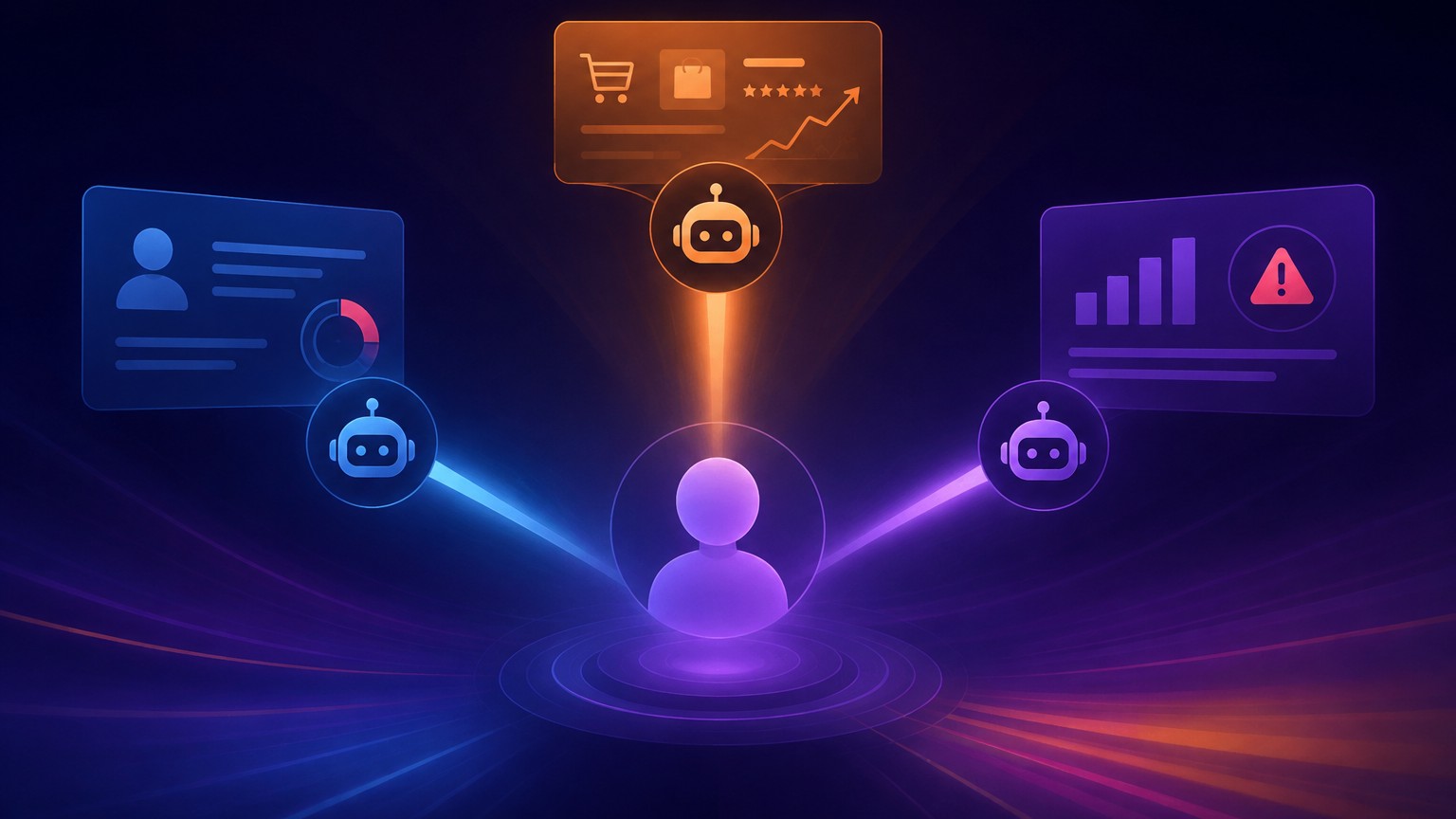
Unified Intelligence Customer Data Ai Agents Business Decisions

How Unified Intelligence Connects Customer Data, AI Agents and Business Decisions

Financial institutions operate in a highly competitive, regulation-driven, and margin-sensitive environment where revenue growth is no longer driven by acquisition alone. Banks, fintechs, and Non-Banking Financial Companies (NBFCs) continue to invest heavily in digital acquisition, yet face persistent challenges such as low onboarding completion, rising contact centre costs, increasing churn, and fragmented customer data. At the same time, customers expect instant responses, seamless onboarding, personalised financial guidance, and consistent service across digital and assisted channels. When these expectations are not met, conversion drops, churn increases, and cost-to-serve rises, often before the impact is fully visible in performance metrics.