
Feature or Infrastructure? How to Tell If an AI Customer Service Vendor Actually Owns the Outcome

Insights / Feature or Infrastructure? How to Tell If an AI Customer Service Vendor Actually Owns the Outcome


AI Vendor Feature vs Infrastructure India

Every AI customer service vendor now describes itself as AI-native, agentic, or built for automation. For buyers, these labels can make it difficult to understand what the technology actually does.

A more useful question is: Does the system resolve the customer’s problem itself, or does it simply help a person resolve it faster? That distinction separates a tool that improves an existing task from a system that takes responsibility for an outcome.

The Real Test: Accelerating a Task vs. Owning the Outcome

Consider two examples.

AI that accelerates a task. A tool receives a customer message and generates a suggested response.

The agent still needs to:

  • Read the customer’s message
  • Review the suggested response
  • Check whether it is accurate
  • Decide what action to take
  • Send the response
  • Own the result

The AI has made part of the agent’s job faster and owns the outcome.

A different system receives the same enquiry and:

  • Understands the customer’s request
  • Checks the relevant information
  • Resolves the issue
  • Takes an authorised action
  • Escalates only when human judgement is required

Here, the system is handling the outcome rather than simply assisting with one task. Neither approach is inherently wrong. A drafting tool can provide a useful productivity improvement. But the two approaches create very different levels of value and dependency for the business. For buyers evaluating AI-native customer service platforms, understanding that difference is important.

Why the Difference Matters

A business using AI to generate draft responses can usually change vendors without fundamentally changing its customer service operation. The underlying workflow remains with the business.

The people, processes and judgement required to resolve the customer’s issue are still in place. An outcome-focused system becomes much more closely connected to the actual customer-service process.

It is responsible for handling more of the work involved in resolving a case, including understanding the request, accessing relevant information and taking the appropriate action.

Over time, this can create a deeper relationship between the business and the system because the AI is being used to perform a specific customer-service job rather than simply providing assistance alongside it.

Questions to Ask Any AI Customer Service Vendor

When evaluating an AI customer service platform, ask these questions.

1. Does the system resolve queries independently?

Ask whether the AI:

  • Resolves the customer’s enquiry directly
  • Takes authorised actions
  • Escalates only when necessary

If every response still requires a human to review and approve it, the system is primarily accelerating a task.

2. Does the system improve as usage increases?

Find out whether the platform can become more effective as it handles more customer interactions.

Ask:

  • Does it learn from resolved cases?
  • Can it identify recurring patterns?
  • Does performance improve as the volume of interactions grows?
  • Does every new scenario require manual configuration?

A system that requires extensive manual reconfiguration for every new situation may provide less autonomous value than its AI positioning suggests.

3. Does customer context carry across channels?

Customer conversations rarely happen through one channel.

A customer may move between:

  • WhatsApp
  • Voice
  • Email
  • Chat

Ask whether the system maintains the same context when the interaction moves between channels.

If the customer has to repeat their information after every handoff, the AI may be handling individual conversations rather than the complete customer interaction.

4. What happens when the AI cannot resolve a case?

This is one of the most important questions to ask.

A well-designed system should be able to escalate the case with the relevant context attached.

The human agent should be able to see:

  • What the customer asked
  • What information was checked
  • What actions were already taken
  • Why the case was escalated

The agent can then continue from the point where the AI stopped.

5. How much of the implementation depends on people?

Ask how much ongoing work is required from the vendor or implementation team.

Consider:

  • Initial configuration
  • New use cases
  • Workflow changes
  • Ongoing reconfiguration
  • New channels
  • New customer scenarios

If every change requires significant external intervention, the product may depend heavily on services rather than handling more of the work itself.

Why the Difference Compounds Over Time

The difference between task assistance and outcome ownership becomes more significant as the system is used.

A drafting tool may continue to provide useful suggestions after 18 months. But the underlying customer-service process still depends on people. An outcome-focused system can handle a much larger number of customer cases over the same period.

It can accumulate experience from those interactions and help identify:

  • Common customer requests
  • Recurring resolution patterns
  • Cases that can be handled automatically
  • Situations that require human intervention

As more routine cases are resolved directly, the number of situations requiring human involvement can potentially decrease. The result is a widening difference between a tool that supports a process and a system that performs more of the process itself.

AI Vendor Feature vs Infrastructure

A Practical Example: A Delayed Refund

Consider a customer contacting a business about a delayed refund.

With a task-assistance tool, the AI might generate a response such as an acknowledgement.

The agent still needs to:

  • Check the customer’s order
  • Check the refund status
  • Understand why the refund is delayed
  • Decide what information to provide
  • Respond to the customer

The AI has reduced some of the writing effort. With an outcome-focused system, the AI can:

  • Understand the customer’s request
  • Check the order
  • Check the refund status
  • Explain the current status
  • Process the refund if the relevant policy allows it
  • Escalate the case if human judgement is required

The second approach handles more of the actual resolution process. The distinction is therefore not simply about how quickly a person can complete a task. It is about how much of the customer outcome the system can handle directly.

Where Worktual Fits

Worktual’s AI Contact Centre is designed around direct customer-service resolution across chat and voice. Its conversational AI can handle routine customer queries such as:

  • Order status
  • Appointment changes
  • Account questions
  • Common service enquiries

When a case requires human judgement, the interaction can be escalated with the relevant context attached. This allows the human agent to take over with an understanding of the conversation and the work already completed by the AI.

Shared Intelligence Across Customer Interactions

Worktual can also connect its AI Contact Centre with Cognitive CDP and other Worktual solutions. This allows customer information and interaction history to be available as part of a broader customer context rather than being isolated within individual channels.

The value is Shared Intelligence: Customer context → AI understanding → Action → Human escalation when required

This gives the AI and human teams a more consistent view of the customer throughout the interaction.

Book a Free Worktual AI Demo.

What Buyers Should Really Look At

When comparing AI customer service vendors, the number of AI features on a product page tells you very little by itself.

Look at what the system can actually do. Use this checklist:

  • Can it resolve customer queries independently?
  • Can it take authorised actions?
  • Can it work across channels without losing context?
  • Can it determine when human intervention is needed?
  • Does escalation include the full case history?
  • Can it improve as interaction volume increases?
  • How much ongoing configuration does it require?
  • How much of the implementation depends on external services?
  • Can it work with the customer’s broader data and systems?

These questions give buyers a more practical way to evaluate AI-native claims.

Conclusion

“AI-native” has become a common description across the customer-service technology market. For buyers, the more useful test is what happens when a real customer interaction reaches the system.

Does the AI: Suggest → Human reviews → Human acts

or:

Understand → Resolve → Act → Escalate when necessary

The first model can improve employee productivity. The second can change how the customer-service process itself operates. That difference matters when evaluating an AI investment because it affects the amount of work the system can take on, how deeply it becomes part of the customer-service operation and how much value it can create over time. The best way to evaluate a vendor is therefore to move beyond the feature list and test the actual customer outcome.

Frequently Asked Questions

1. What’s the difference between an AI tool that accelerates a task and one that owns an outcome?

A task-accelerating tool prepares something for a person, such as a draft response or recommendation. An outcome-focused system can resolve the customer query directly and involve a person when the case requires human judgement or falls outside the system’s authorised actions.

2. Why does this distinction matter when choosing an AI vendor?

A task-assistance tool leaves most of the existing customer-service process with the business. An outcome-focused system takes responsibility for more of the actual resolution process. This can create greater operational value, while also making the vendor a more important part of the business’s customer-service infrastructure.

3. How can a business tell which type of AI system it is evaluating?

Ask whether the system:

  • Resolves queries independently
  • Requires human approval for every response
  • Improves with increased usage
  • Maintains context across channels
  • Escalates cases with full context
  • Requires significant manual reconfiguration

These questions provide a practical way to distinguish task assistance from outcome ownership.

4. Does an outcome-focused AI system remove the need for human agents?

No. The role of human agents changes rather than disappearing. AI can handle routine and well-defined customer cases directly, while complex, sensitive or unusual cases can be escalated to human agents with the relevant context attached.

5. How does Worktual’s AI Contact Centre fit this distinction?

Worktual’s AI Contact Centre is designed to resolve routine customer queries directly across chat and voice. When a case requires human judgement, it can be escalated with the relevant context so the agent can continue the interaction without starting again.

Related Posts

Ai Insurance Pre Authorization Verification india

Can AI Actually Verify Insurance Pre-Authorization Status, or Just Report What a Human Already Knows?

Financial institutions operate in a highly competitive, regulation-driven, and margin-sensitive environment where revenue growth is no longer driven by acquisition alone. Banks, fintechs, and Non-Banking Financial Companies (NBFCs) continue to invest heavily in digital acquisition, yet face persistent challenges such as low onboarding completion, rising contact centre costs, increasing churn, and fragmented customer data. At the same time, customers expect instant responses, seamless onboarding, personalised financial guidance, and consistent service across digital and assisted channels. When these expectations are not met, conversion drops, churn increases, and cost-to-serve rises, often before the impact is fully visible in performance metrics.
Conversational Ai Loan Status India

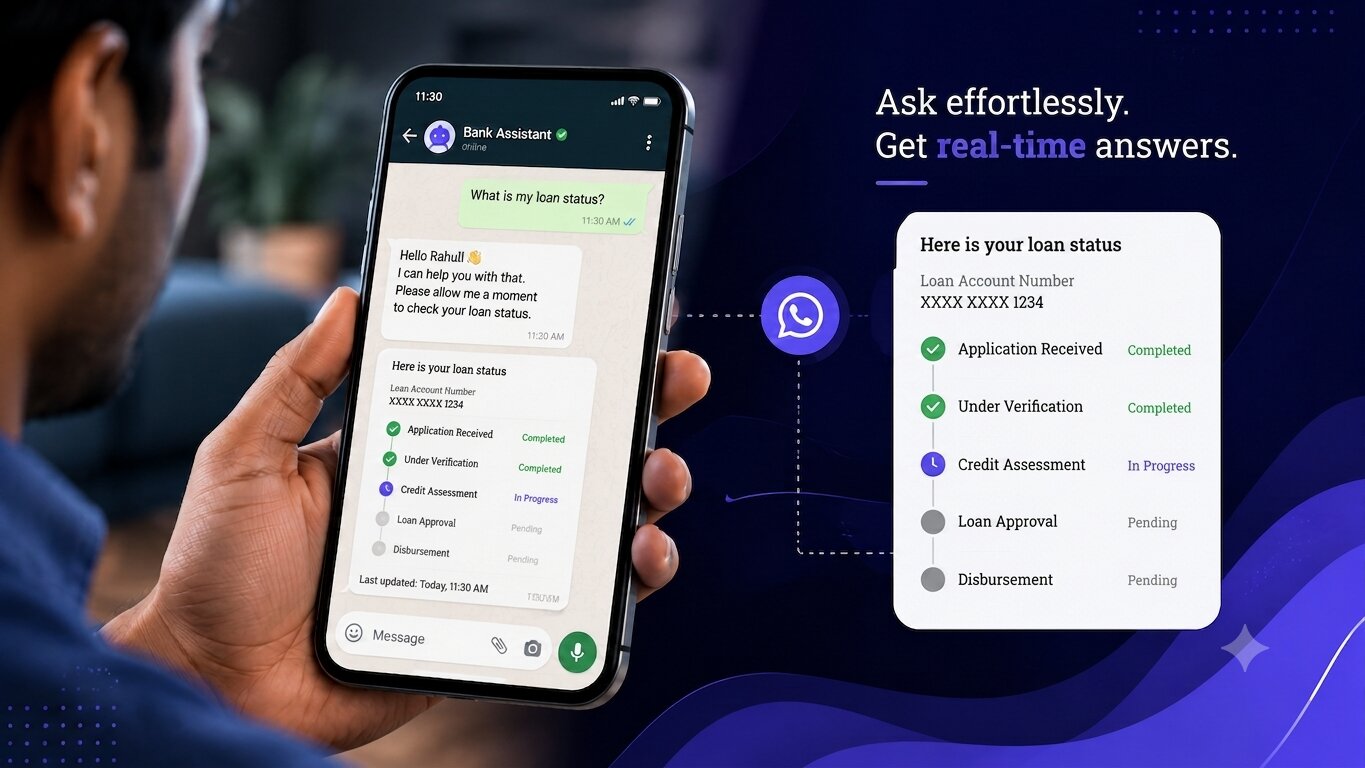
How Conversational AI Checks Loan and Disbursement Status in Real Time and When It Still Hands Off to a Human

A loan applicant hears nothing for five days. Unsure whether the application is delayed or simply being processed, she calls customer support—not because something went wrong, but because nobody told her everything was progressing as expected.

DPDP Consent Manager Framework India

Does Your Business Need to Register as a DPDP Consent Manager?

Financial institutions operate in a highly competitive, regulation-driven, and margin-sensitive environment where revenue growth is no longer driven by acquisition alone. Banks, fintechs, and Non-Banking Financial Companies (NBFCs) continue to invest heavily in digital acquisition, yet face persistent challenges such as low onboarding completion, rising contact centre costs, increasing churn, and fragmented customer data. At the same time, customers expect instant responses, seamless onboarding, personalised financial guidance, and consistent service across digital and assisted channels. When these expectations are not met, conversion drops, churn increases, and cost-to-serve rises, often before the impact is fully visible in performance metrics.