

Unified Intelligence AI for F&B Hospitality: Increasing Covers, Guest Spend, and Revenue
Insights / Unified Intelligence AI for F&B Hospitality: Increasing Covers, Guest Spend, and Revenue

Table of Contents
In the food and beverage (F and B) sector, hospitality operators such as restaurants, pubs, and bars operate in a tightly managed commercial environment where revenue depends on converting demand into confirmed bookings, maximising spend per guest, and driving repeat visits over time. Covers, sitting time, menu mix, and return frequency all influence profitability, while rising labour costs and margin pressure leave little room for operational waste. Guests expect immediate responses, seamless booking journeys, and personalised support across digital and physical touchpoints, so the cost of failing to meet these expectations compounds with every missed cover.
Many operators still rely on fragmented systems that limit visibility into guest intent and long-term value. Reservation platforms, point of sale (POS) data, guest messaging, loyalty activity, and marketing tools frequently operate without integration. Teams then absorb high volumes of repetitive enquiries around availability, menus, dietary requirements, and reservation changes, increasing workload and reducing response speed during the very periods when demand needs to be converted most efficiently.
Worktual consolidates these operational and commercial challenges into a single, integrated intelligence model built specifically around how hospitality businesses generate and retain revenue. Rather than layering tools onto existing gaps, the approach begins with a consultancy-led diagnostic that identifies where demand is being lost, where guest engagement breaks down, and where operational strain is reducing commercial output. The Worktual Cognitive Data Platform sits at the centre of this model, drawing together booking data, guest interactions, service history, and spend behaviour into a continuously updated intelligence layer. This allows operators to act on intent in real time, personalise engagement across the guest lifecycle, and make better commercial decisions – resulting in stronger cover conversion, higher spend per visit, and more consistent repeat revenue.
- What unified intelligence means for F&B booking performance and guest lifecycle management
- F&B pain points reducing covers, increasing service pressure, and limiting repeat visits
- Solutions F&B operators need to improve booking conversion, efficiency, and guest spend
- Impact, ROI, and revenue growth from unified intelligence in F&B hospitality
- Why Worktual works for restaurants, pubs, and bars
- FAQs
What unified intelligence means for Food & Beverage booking performance and guest lifecycle management
Unified intelligence for restaurants, pubs, and bars means connecting guest data, booking activity, service interactions, and lifecycle engagement into one continuously learning operating system. Instead of relying on isolated reservation platforms, POS systems, messaging tools, and customer relationship management (CRM) records, operators work from a shared intelligence layer that gives a more complete picture of each guest, each booking journey, and each revenue opportunity. This creates a stronger basis for decision-making across demand generation, booking conversion, in-venue service, event management, and repeat visit strategy across the operation.
At the centre of this model sits the Worktual Cognitive Data Platform. It acts as the intelligence hub by bringing together signals from reservations, transactions, guest profiles, service history, campaign engagement, and behaviour across channels. That central layer tracks what has happened, helps explain why it happened, and supports better prediction of what is most likely to happen next. From there, connected capabilities apply that intelligence across the business, ensuring that booking enquiries, service responses, targeted offers, and retention campaigns all operate from the same view of the guest and the same commercial priorities.
For restaurant, pub, and bar operators, this changes how growth is managed. Booking performance improves because teams can respond faster and with more context. Spend per guest improves because preferences and visit patterns are clearer. Repeat revenue improves because engagement becomes more structured across the lifecycle. Unified intelligence therefore supports stronger commercial control, better guest experience, and more efficient execution across front-of-house, marketing, events, and management functions, which is critical for both independent venues and multi-site groups.
Food & Beverage pain points reducing covers, increasing service pressure, and limiting repeat visits
Restaurants, pubs, and bars face operational challenges that directly reduce covers, increase cost-to-serve, and limit long-term revenue potential. One of the most immediate issues is lost bookings caused by delayed or incomplete responses to enquiries. Guests expect quick confirmation on availability, menus, dietary requirements, private hire options, and reservation terms, and when that clarity is missing they often leave the journey before confirming. That means demand exists, but revenue is lost before the guest ever arrives, particularly at peak trading moments and high-value occasions.
Service pressure adds another layer of difficulty. Teams manage a constant flow of repetitive queries across phone, web chat, email, social, and messaging channels, including booking amendments, table size changes, opening hours, menu detail, accessibility, and event questions. Handling this manually increases workload, slows response times, and creates inconsistency across guest interactions. During peak trading windows, those delays can affect both conversion and the quality of the in-venue experience because staff attention is split between service delivery and admin-heavy communication, creating strain across the operation.
Data fragmentation then weakens the commercial picture further. Guest information is spread across booking systems, POS platforms, loyalty tools, guest notes, and campaign channels, which prevents operators from building a unified view of behaviour and value. This limits personalisation, weakens repeat-visit strategy, and leaves upsell opportunities underused. The result is lower booking conversion, more operational friction, reduced spend per guest, and weaker lifetime value across the customer base, even when guest demand remains healthy.
Solutions Food & Beverage operators need to improve booking conversion, efficiency, and guest spend
Improving performance requires a connected system that aligns guest data, engagement, and execution across the full lifecycle. That starts with a Worktual Cognitive Data Platform that consolidates booking history, spend data, messaging activity, service interactions, preferences, and campaign responses into one real-time intelligence layer. With that visibility, operators can identify high-value guests, understand booking behaviour more clearly, and make more informed decisions across reservations, service, events, and marketing. This gives management a stronger operational view while also improving the timing and relevance of guest engagement across every touchpoint.
That intelligence then needs to be activated through connected capabilities across the business. Conversational AI can respond immediately to booking enquiries, menu questions, dietary concerns, reservation changes, and event requests, reducing missed opportunities and increasing response consistency. Omnichannel service capability can manage communication across channels more efficiently, while structured ticketing and workflow management improve coordination for larger bookings, special requests, pre-visit planning, and post-visit follow-up. These connected workflows reduce manual strain and improve operational control across busy trading periods and complex guest occasions.
The commercial layer comes through guest value management and lifecycle orchestration. With better segmentation, operators can prioritise regulars, identify guests with higher spend potential, and build more effective offers around events, seasonal campaigns, loyalty, and rebooking. Automated lifecycle journeys can support confirmation, reminders, return incentives, private event marketing, and post-visit engagement. Together, these capabilities create a more responsive and profitable system that improves booking conversion, increases guest spend, and supports sustained repeat revenue.
Impact, ROI, and revenue growth from unified intelligence in Food & Beverage hospitality
Worktual’s unified intelligence delivers measurable impact across booking performance, operational efficiency, spend per guest, and repeat revenue. Faster response to enquiries improves booking conversion by reducing friction at the point of intent, while clearer guest data helps teams handle demand with greater confidence and control. More confirmed reservations, fewer lost enquiries, and better table utilisation all contribute directly to higher top-line performance, especially during peak periods where response quality influences whether demand is captured or lost and where every seat matters commercially and operationally every day.
Revenue per guest also becomes easier to improve. Better visibility into preferences, visit history, occasion type, and booking behaviour supports more relevant recommendations, stronger event targeting, and more effective upsell opportunities. That can include premium menus, celebration packages, private dining, drinks-led occasions, group bookings, and return incentives. As lifecycle engagement becomes more structured, repeat visit frequency and total lifetime spend improve, giving operators a stronger revenue base and more dependable repeat trade across the calendar.
Operational efficiency adds another layer of ROI. Automation of repetitive guest queries reduces pressure on front-of-house and management teams, while better workflow visibility improves consistency across booking handling, special requests, and service coordination. That means less manual administration, fewer avoidable errors, and more capacity to focus on the guest experience inside the venue. Combined, these improvements strengthen margins, improve commercial control, and create a more scalable operating model across single sites and multi-venue portfolios with greater confidence and operational discipline.

Why Worktual works for restaurants, pubs, and bars
Worktual works for F&B operators because it treats booking conversion, guest engagement, and repeat revenue as one connected commercial challenge rather than as functions managed through separate systems. It begins with a consultancy-led assessment of each operation, identifying where bookings are being lost, where service pressure is highest, where guest data is fragmented, and where repeat revenue remains underdeveloped. This ensures the solution is shaped around the realities of the business, including venue format, demand profile, service model, operational constraints, and growth priorities.
Worktual’s solution is built on its Cognitive Data Platform, which serves as the central hub of this model, unifying guest data, transaction history, service activity, campaign response, and behavioural signals into a continuously updated operating layer. Connected capabilities then apply these insights across the business through real-time guest engagement, coordinated service communication, workflow management, guest value optimisation, and lifecycle activation. Worktual’s proprietary AI keeps sensitive guest and transaction data protected at every level – from access controls to how data is handled and stored – enabling operators to maintain commercial focus without operational risk.
Worktual continues to optimise performance over time, ensuring the system evolves alongside the venue or group. This supports stronger booking conversion, higher spend per guest, reduced operational strain, and more consistent repeat revenue across the full guest lifecycle. For restaurant, pub, and bar operators focused on profitable growth, Worktual provides a bespoke, integrated path to improved commercial outcomes through one unified intelligence system that is designed to enhance performance where it matters most and support scalable growth with greater consistency.
Discover how Worktual can increase restaurant and bar bookings, improve guest spend, and drive repeat revenue through unified intelligence tailored to your operation.
FAQs
1. What is unified intelligence in restaurants, pubs, and bars?
A unified intelligence platform for F&B operators connects booking data, guest interactions, service activity, and lifecycle engagement into a single AI-powered restaurant lifecycle platform. It continuously improves decision-making and overall performance.
2. How does it increase booking conversion?
A restaurant AI platform using an AI chatbot for restaurants and restaurant booking automation enables immediate, consistent responses to enquiries. It reduces friction in the booking journey and captures demand at the moment of intent through an intelligent restaurant reservation system.
3. How does the Worktual Cognitive Data Platform help a restaurant?
A restaurant CDP within a restaurant data analytics platform consolidates guest data, booking history, spend behaviour, messaging activity, and service interactions. It enables AI-driven restaurant insights for faster and more informed decisions.
4. Does AI in the Hospitality Industry reduce staff workload?
Yes. A restaurant automation platform powered by AI for restaurant operations handles repetitive guest queries and workflow tasks. It reduces manual administration and allows teams to focus more on service delivery and guest experience.
5. How does it increase spend per guest?
A restaurant customer engagement platform uses AI menu recommendations, personalised dining experience AI, and upselling strategies to increase average order value in restaurants. It delivers more relevant offers based on guest behaviour and preferences.
6. Does it improve repeat visits?
Yes. A restaurant CRM software combined with a restaurant customer engagement platform enables structured guest lifecycle management. It strengthens retention, loyalty, and repeat bookings through targeted communication.
7. Can it support group bookings, private hire, and event-driven demand?
Yes. An AI reservation system for restaurants with restaurant waitlist management system capabilities manages complex bookings and automates workflows. It improves efficiency for group reservations and event-driven demand.
8. Will it work with existing booking systems and POS platforms?
Yes. A unified AI platform for F&B hospitality integrates with existing restaurant management software, POS integration AI restaurant systems, and reservation tools. It fits into current operations without requiring full system replacement.
9. What commercial outcomes can operators expect?
A restaurant revenue management approach powered by restaurant revenue optimisation and AI for restaurant sales growth delivers stronger booking conversion, better table utilisation, higher guest spend, and more predictable revenue. It also reduces operational pressure.
10. Why Worktual’s Unified Intelligence for Hospitality works for restaurants, pubs, and bars?
Worktual’s unified intelligence for restaurants, pubs, and bars delivers a unified intelligence restaurant model that functions as a restaurant lead-to-revenue platform and AI-driven restaurant growth platform. It connects guest data, engagement, and operations to maximise covers, spend, and revenue.
Related Posts
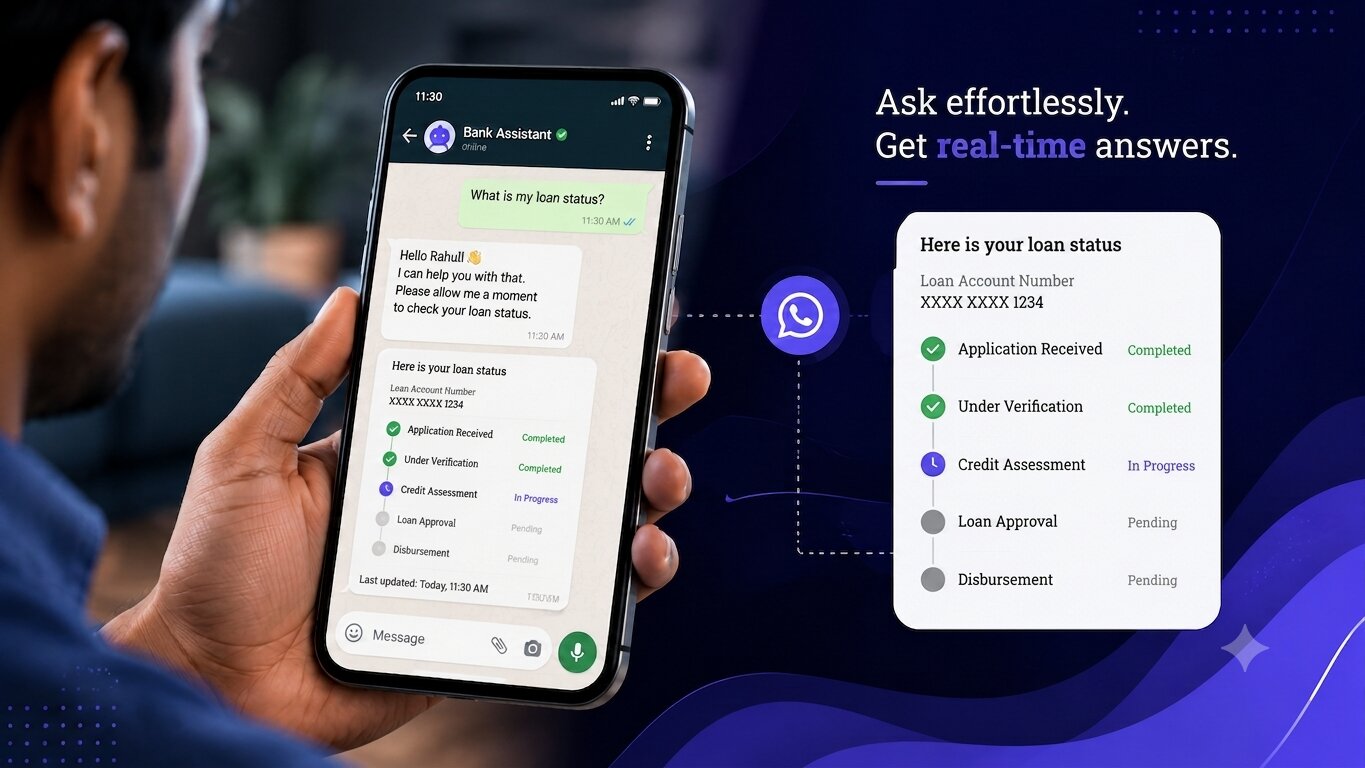
How Conversational AI Checks Loan and Disbursement Status in Real Time and When It Still Hands Off to a Human
A loan applicant hears nothing for five days. Unsure whether the application is delayed or simply being processed, she calls customer support—not because something went wrong, but because nobody told her everything was progressing as expected.
How Unified Intelligence Connects Customer Data, AI Agents and Business Decisions
Financial institutions operate in a highly competitive, regulation-driven, and margin-sensitive environment where revenue growth is no longer driven by acquisition alone. Banks, fintechs, and Non-Banking Financial Companies (NBFCs) continue to invest heavily in digital acquisition, yet face persistent challenges such as low onboarding completion, rising contact centre costs, increasing churn, and fragmented customer data. At the same time, customers expect instant responses, seamless onboarding, personalised financial guidance, and consistent service across digital and assisted channels. When these expectations are not met, conversion drops, churn increases, and cost-to-serve rises, often before the impact is fully visible in performance metrics.

Most Campaign Tools Still Measure Clicks. The Revenue Is Somewhere Else.
Financial institutions operate in a highly competitive, regulation-driven, and margin-sensitive environment where revenue growth is no longer driven by acquisition alone. Banks, fintechs, and Non-Banking Financial Companies (NBFCs) continue to invest heavily in digital acquisition, yet face persistent challenges such as low onboarding completion, rising contact centre costs, increasing churn, and fragmented customer data. At the same time, customers expect instant responses, seamless onboarding, personalised financial guidance, and consistent service across digital and assisted channels. When these expectations are not met, conversion drops, churn increases, and cost-to-serve rises, often before the impact is fully visible in performance metrics.


