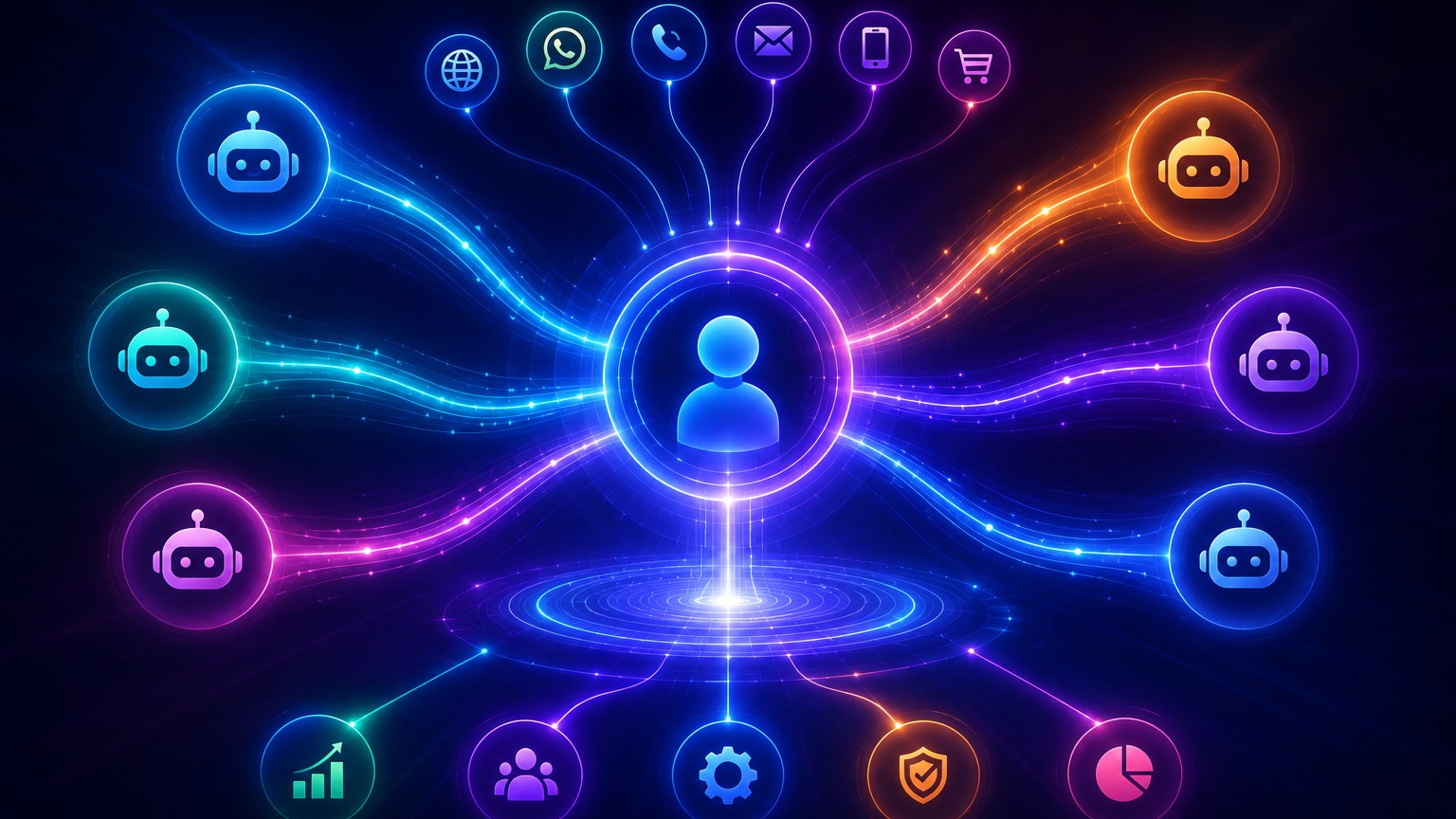
How Unified Intelligence Connects Customer Data, AI Agents and Business Decisions

Insights / How Unified Intelligence Connects Customer Data, AI Agents and Business Decisions
Unified Intelligence Customer Data Ai Agents Business Decisions

Indian enterprises are moving quickly from experimenting with AI to deploying multiple AI agents across sales, service, marketing and customer operations.

But there is a problem that becomes more visible as those agents multiply: they may not be working from the same customer context.

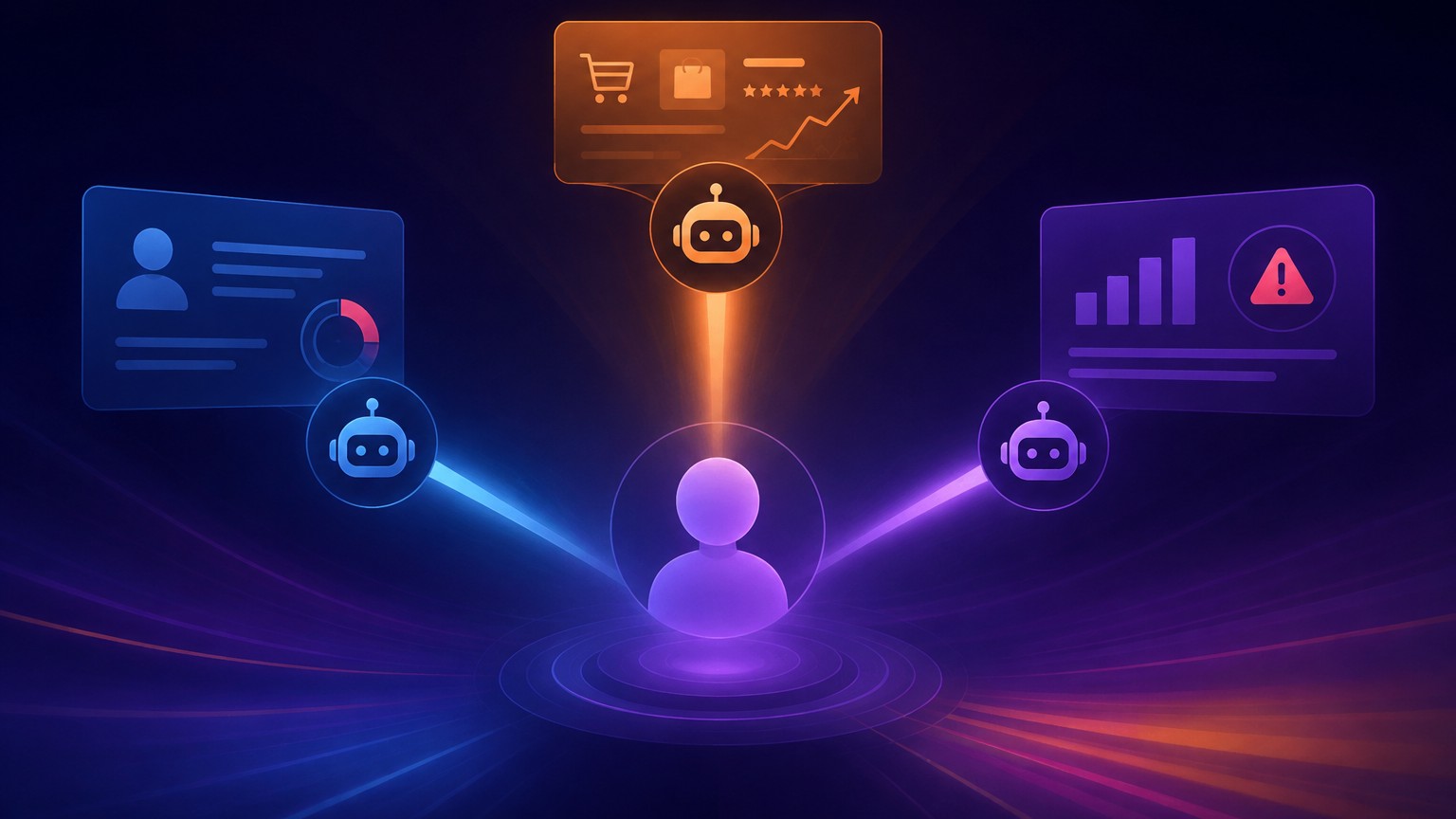
Imagine a bank using three AI agents for the same customer:

  • One monitors service interactions and flags potential issues.
  • Another identifies customers at risk of churn.
  • A third recommends the next best offer to the relationship manager.

Each agent may perform its role well. But if they are drawing from different, disconnected customer data, they can reach very different conclusions about the same person.

One agent sees a customer who looks ready to leave. Another sees a customer who is ready for an upgrade. Neither has the complete picture. The problem isn’t necessarily the AI agent. It’s the intelligence layer behind it.

This is becoming increasingly important as Indian enterprises scale their use of AI. Research points to data readiness and integration as major barriers to moving AI and agentic AI beyond experimentation and into broader enterprise deployment.

The question, therefore, is no longer simply “How many AI agents should we deploy?”

It is:

“Are all those agents working from the same understanding of the customer?”

That is where Unified Intelligence comes in.

The real bottleneck isn't the AI agent, it's the data behind it

Indian enterprises have adopted AI agents at a striking pace. According to Salesforce’s India findings from its State of Marketing research, 81% of marketers in India have already adopted AI. But the same research found that 86% would trust AI to handle customer interactions at scale if disjointed, siloed data weren’t holding them back. EY’s AIdea of India research found a similar pattern from the technology side: 78% of Indian enterprises name integration and data readiness as their single biggest barrier to scaling generative and agentic AI, and 53% call it a severe constraint once they try to move past pilot stage.

Globally, McKinsey has found that eight in ten companies cite data limitations, not model quality, as the roadblock to scaling agentic AI. Gartner projects that AI agents will be embedded in 40% of enterprise applications by the end of 2026, up from under 5% in 2025 — but also predicts that a large share of these projects will be abandoned specifically because the underlying data was not agent-ready.

The direct-answer version: an AI agent is only as reliable as the customer context it can see. Deploying more agents onto fragmented data does not multiply intelligence — it multiplies the chances that agents disagree with each other.

Why fragmentation is especially acute for Indian enterprises

Three factors compound the problem for businesses operating in India specifically:

FactorWhy it fragments customer context
Channel diversityCustomers move across app, WhatsApp, call centre, branch and UPI-linked payment rails, often within a single journey, with each channel logging data separately
Consent-first regulationUnder the DPDP Act, 2023 and the DPDP Rules, 2025, there is no legitimate-interest basis for data use; consent must be explicit and purpose-limited, which means every system touching customer data needs a clean, auditable record of what it's allowed to do with it
Legacy core systemsMany Indian enterprises run core banking, insurance or telecom systems that predate cloud-native architecture, so customer records are split across systems that were never designed to talk to each other

The DPDP Rules, notified in November 2025, also mean the cost of getting this wrong is rising. A fragmented data estate is not just an AI performance problem in India; it is a compliance exposure, since organisations must be able to show which system holds what data, under what consent, and for what purpose

What "Unified Intelligence" actually means

Unified Intelligence” is often used loosely to describe any AI-powered system. Precisely, it describes two distinct layers working together, and the distinction matters for anyone building or buying this kind of architecture.

LayerWhat it doesWhat it does not do
Cognitive CDP (Customer Data Platform)Captures and unifies customer data from every channel and system into one continuously current profile, in real timeDoes not score, predict or recommend on its own
CVM (Customer Value Management)The strategy layer built on the unified profile — scores churn risk, purchase intent and lifetime value, and determines the next-best-actionCannot function without a reliably unified profile to work from

Worktual‘s Cognitive CDP exists specifically to solve the capture-and-unification problem, so that the CVM layer, and any AI agent built on top of it, is reasoning from one current, consented view of the customer rather than several conflicting ones.

How Unified Intelligence Connects Customer Data AI Agents

How this connects to day-to-day business decisions

Once customer data is unified, the connection to AI agents and business decisions becomes direct rather than theoretical:

  • Consistent next-best-action. A single CVM layer scoring churn and intent means a service agent, a sales agent and a retention agent all draw the same conclusion about a customer, instead of three different ones.
  • Faster, auditable decisions. When data lineage is unified rather than scattered, consent and purpose-limitation checks required under the DPDP Rules can be applied once, centrally, rather than re-verified in every downstream system.
  • Fewer abandoned AI projects. Since data readiness is the leading cause of agentic AI project failure, according to Gartner, unifying the data layer before scaling agents directly reduces that failure rate.
  • Measurable business outcomes. Next-best-action and churn scoring only produce value the business can act on when they’re built on a profile that reflects the customer’s most recent interaction, not one that is hours or days out of date.

Where this fits for enterprises evaluating AI agent strategy

Enterprises evaluating agentic AI in India would do well to treat the data layer as the first decision, not the last one. Worktual’s architecture is built around this sequencing: Cognitive CDP unifies the customer record first, and CVM, along with AI CRM and other agent-facing products, draws on that single record for scoring and decisioning. This does not eliminate the broader industry challenge of agent reliability and governance; that remains an open, industry-wide problem that unified data alone does not solve. What it does address is the specific failure pattern described above: agents that disagree with each other because they were never looking at the same customer to begin with.

Ready to see how a unified Cognitive CDP and CVM layer could support your AI agent strategy?

Talk to Worktual.

FAQ

1. What is unified intelligence in customer data platforms?

Unified intelligence refers to combining a single, real-time customer profile (built by a CDP) with a decisioning layer (like CVM) that scores and acts on that profile. Without unification first, AI agents work from partial or conflicting data, which is why fragmented data, not model quality, is the leading cause of agentic AI project failure.

2. Why do AI agents give inconsistent recommendations to the same customer?

This usually happens when different agents draw from different, unsynced data sources. If a service agent and a sales agent each see only part of a customer’s history, they will reach different conclusions. A unified customer data layer removes this by giving every agent the same current profile to reason from.

3. How does India’s DPDP Act affect customer data unification?

The DPDP Act, 2023 and DPDP Rules, 2025 require explicit, purpose-limited consent for data use, with no legitimate-interest basis available. This means a unified data layer must also unify consent records, so every system and agent using customer data can show what it is authorised to do with it.

4. What’s the difference between a CDP and a CVM layer?

A Cognitive CDP captures and unifies customer data into one continuously current profile; it does not score or predict. CVM (Customer Value Management) is the strategy layer built on top of that profile — it handles churn scoring, lifetime value and next-best-action decisions.

5. Do more AI agents automatically improve customer outcomes?

Not on their own. Gartner and McKinsey research both point to fragmented, non-agent-ready data as the leading reason agentic AI projects stall or get abandoned. Adding agents on top of siloed data tends to multiply inconsistency rather than intelligence.

Related Posts

Ai Hesitation Hindi English Code Switching

Can AI Read Between the Lines? What Hesitation Sounds Like in Hindi and English, Mixed

A loan applicant hears nothing for five days. Unsure whether the application is delayed or simply being processed, she calls customer support—not because something went wrong, but because nobody told her everything was progressing as expected.

AI Native Indian Healthcare

Why AI-Native Matters More in India’s Healthcare System Than Anywhere Else

Financial institutions operate in a highly competitive, regulation-driven, and margin-sensitive environment where revenue growth is no longer driven by acquisition alone. Banks, fintechs, and Non-Banking Financial Companies (NBFCs) continue to invest heavily in digital acquisition, yet face persistent challenges such as low onboarding completion, rising contact centre costs, increasing churn, and fragmented customer data. At the same time, customers expect instant responses, seamless onboarding, personalised financial guidance, and consistent service across digital and assisted channels. When these expectations are not met, conversion drops, churn increases, and cost-to-serve rises, often before the impact is fully visible in performance metrics.

Ai CRM for Higher Education

AI CRM for Higher Education: The Complete Guide for Indian Institutions

An AI CRM for higher education is admissions software that scores, routes, and follows up with prospective students automatically, rather than requiring a counsellor to manually track every enquiry. India’s National Education Policy 2020 targets a 50% Gross Enrolment Ratio in higher education by 2035, up from 28.4% in 2021–22 — a scale of growth Indian institutions cannot manage with manual, spreadsheet-driven admissions processes.