From WhatsApp to Website: Predicting Customer Intent Across India’s Fragmented Digital Journeys

Insights / From WhatsApp to Website: Predicting Customer Intent Across India’s Fragmented Digital Journeys

WhatsApp to Website Buyer Journey

The Fragmented Indian Journey

A typical Indian buying journey moves from a discovery ad on Instagram, to a WhatsApp conversation, to a website product page, and back to WhatsApp for a UPI payment. The customer’s intent is one continuous thread; the data describing it is scattered across four disconnected systems

WhatsApp Driven Customer Journey

This fragmentation is not a minor inconvenience. Conversational commerce spend is projected to reach approximately $135 billion globally by 2027, according to Juniper Research, reflecting how central channels like WhatsApp have become to the purchase decision itself; not simply a support channel running alongside it. For Indian brands specifically, the gap between where intent is expressed and where it is analysed is the single largest reason predictable, high-converting signals go unactioned.

• Why Intent Breaks Across Channels

• The Signals That Predict Intent

• The India Dimension

• Unifying the Journey — And How to Start

• FAQs

Why Intent Breaks Across Channels

Each channel captures a genuine fragment of customer intent, but none of them communicate with the others by default. A WhatsApp enquiry, an anonymous website visit, and a UPI transaction look like three unrelated events unless they are deliberately stitched into a single profile.

ChannelIntent signal it capturesWhat it misses alone
WhatsAppQuestions, product interest, negotiation, voice notesPrior browsing history and catalogue depth
WebsitePages viewed, catalogue depth, cart activityWho the anonymous visitor actually is
Ads / socialFirst-click intent (click-to-WhatsApp, QR)Whether interest converted downstream
UPI / paymentPurchase confirmation, valueThe research journey that led there

Read in isolation, none of these four channels tells the full story. A website session shows interest without identity; a WhatsApp thread shows identity and interest without browsing depth; a UPI transaction confirms value without any visibility into the research that preceded it. The commercial opportunity lies specifically in the reconciliation of these fragments, not in improving any single channel further.

The Signals That Predict Intent

Conversational signals (WhatsApp):

  • Specific product questions — size, price, availability, or stock queries tied to a location.
  • Repeat enquiries or voice notes, especially in vernacular — a strong indicator of a considered buyer.
  • Cart or catalogue interaction within the chat itself — a strong late-stage signal.

Behavioural signals (website):

  • Repeat visits to the same product page across multiple sessions.
  • Pricing or offers-page activity, indicating comparison behaviour ahead of a purchase.
  • Abandoned cart; typically the single highest-ROI signal to act on via WhatsApp.

Trigger signals (cross-channel):

  • A click-to-WhatsApp interaction from an ad; a peak-intent moment where the buyer has actively raised a hand.
  • A QR-code scan on packaging or in-store, bridging an offline moment to a digital intent signal.

A WhatsApp price enquiry combined with two website visits to the same product and an abandoned cart is a materially stronger signal than any one of these events alone and the combination that should trigger an automated response.

The India Dimension

Predictive intent in India operates under a data-protection regime, language landscape, and payment infrastructure that has no direct equivalent in the US or UK markets.

  • Consent, not legitimate interest. Unlike GDPR, India’s DPDP Act has no legitimate-interest basis for processing. Unifying data across WhatsApp, website, and payments must rest on free, specific, informed, and unconditional consent at every entry point.
  • The Consent Manager framework becomes operational on 13 November 2026. This establishes a single, interoperable interface through which users can grant or withdraw consent; full enforcement follows in May 2027, and brands should design for it now rather than after the deadline.
  • Vernacular is itself a signal of intent. A question asked in Hindi, Tamil, or Malayalam is a high-value indicator, and DPDP notices may themselves be served in any of 22 constitutional languages, making language-aware personalisation a genuinely India-specific advantage.
  • UPI collapses the funnel. In-chat UPI payments mean discovery and purchase can occur in a single WhatsApp thread, compressing the intent-to-purchase window to minutes rather than days.
  • Tier-2 and tier-3 behaviour differs structurally. Voice notes, QR codes, and low-data journeys dominate outside metro markets, meaning intent signals must be read differently in these regions rather than treated as a smaller version of metro behaviour.

The scale of the compliance shift is significant: DPDP penalties can reach up to ₹250 crore per contravention, yet 83% of Indian organisations have not yet begun their compliance implementation, according to RAIL’s 2026 research. This gap represents meaningful commercial risk for any brand unifying customer data ahead of the November 2026 deadline.

Unifying the Journey — And How to Start

Customer Intent Prediction in India

The fix is not a single tool, but a sequence: stitch every channel into one consent-based profile, then act on intent while the window is still open.

  1. Capture consent-first at every entry point — click-to-WhatsApp, website, and QR — rather than retrofitting consent after data is already flowing.
  2. Stitch identities into a single profile, resolving the WhatsApp number, website visitor, and UPI transaction to one customer record.
  3. Score intent across channels, combining conversational, behavioural, and trigger signals into a single readiness score.
  4. Act in the moment, routing high-intent signals to a WhatsApp nudge or personalised offer while the window remains open — typically minutes, not days.

The commercial upside of getting this right is well documented. Personalised WhatsApp messaging can lift conversion by up to 112%, according to Techiegigs, and abandoned-cart recovery remains the highest-ROI WhatsApp tactic available to Indian D2C brands, per Boomimart. Route Mobile’s research further found that live tracking combined with post-purchase support cuts tier-1 churn by approximately 68%.

The practical difficulty is rarely the individual channel; most Indian brands already run WhatsApp, a website, and UPI checkout competently in isolation. The difficulty is identity resolution across all three under a consent-first model, at the speed vernacular, voice-note, and QR-driven behaviour demands.

This is the specific problem Worktual‘s Cognitive CDP is built to solve for the Indian market.

  • Its hub-and-spoke architecture resolves the WhatsApp number, website visitor, and UPI transaction to a single profile automatically, with consent state tracked at the point of capture rather than reconstructed after the fact, a materially different starting point from platforms built for consent regimes that assume legitimate interest as a fallback.
  • On top of this unified profile, an AI-Native NBA engine reads vernacular queries, catalogue interaction, and basket behaviour together, and triggers the next best action typically a WhatsApp nudge while the buyer is still active in that thread.
  • Because the entire loop runs on one profile, teams can track the metrics that matter commercially in one place: time from signal to WhatsApp response (TAT), CSAT following an automated nudge, and the resulting shift in customer lifetime value (LTV) by cohort.

FAQs

1.What does a fragmented customer journey mean in India? 

It means a single customer’s buying intent is split across WhatsApp, website, ads, and UPI payments, with no shared profile connecting them. Each channel sees only its own fragment of the full picture.

2. Why does WhatsApp convert so much better than a website in India?

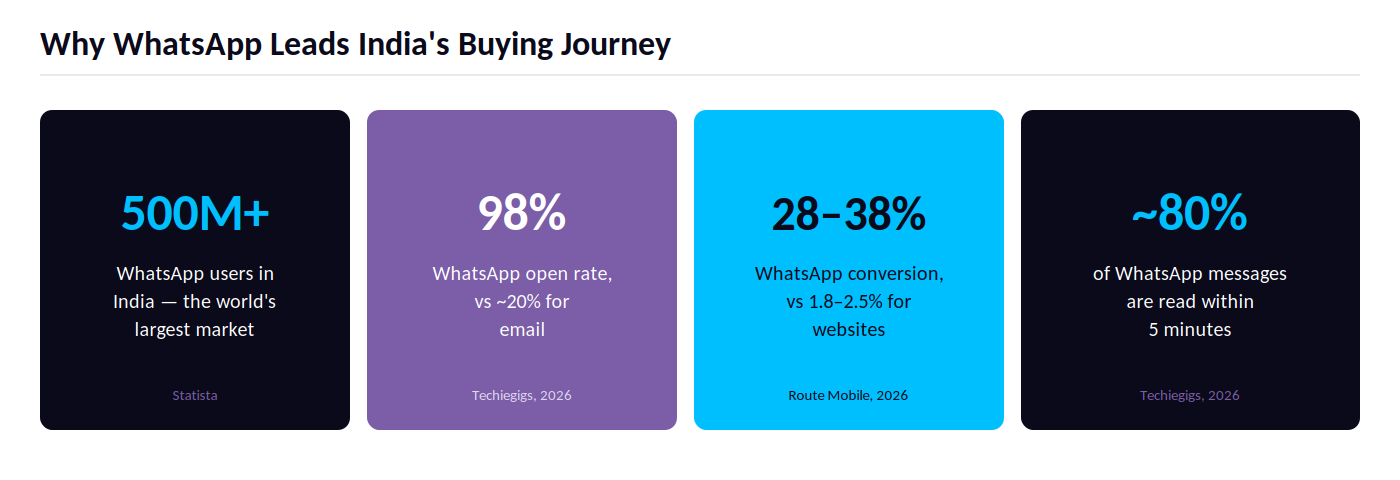
WhatsApp combines a 98% open rate with direct conversational engagement, converting at 28–38% versus 1.8–2.5% for websites. The channel captures identity and intent simultaneously, which websites typically cannot.

3. How do you predict customer intent across channels?

By stitching WhatsApp, website, and payment data into one profile, then scoring conversational, behavioural, and trigger signals together. A signal that appears in isolation is far weaker than the same signal stacked across channels.

4. Is unifying customer data across WhatsApp and website DPDP-compliant?

Yes, provided it is built on free, specific, informed, and unconditional consent captured at each entry point. The DPDP Act has no legitimate-interest basis, so consent must be explicit rather than assumed.

5. What is the DPDP Act and how does it affect intent data?

The DPDP Act is India’s data-protection law, requiring consent-first processing with penalties of up to ₹250 crore per contravention. Its Consent Manager framework becomes operational in November 2026, ahead of full enforcement in 2027.

6.Why does vernacular language matter for customer intent in India?

A question asked in Hindi, Tamil, or another regional language is itself a strong, high-value signal of a considered buyer. DPDP notices may also be served in any of 22 constitutional languages, making language-aware personalisation a genuine differentiator.

7.How can Indian D2C brands start unifying cross-channel intent?

By capturing consent at every entry point first, then stitching WhatsApp, website, and payment identities into one profile. A single automated flow, such as WhatsApp-based abandoned-cart recovery, is a practical starting point.

Related Posts

Ai CRM vs Traditional CRM

AI-Native CRM vs Traditional CRM: What Actually Moves the Revenue Needle

Sales teams already know speed matters. Dr. James Oldroyd’s 2007 MIT/InsideSales.com study found that contacting a lead within 5 minutes makes a rep 100 times more likely to connect than waiting 30. Yet Harvard Business Review’s 2011 audit of 2,241 firms found the average business still takes 42 hours to respond. This isn’t a knowledge gap; it’s a knowing-doing gap. The real question isn’t whether speed matters. It’s which system actually closes that gap, rather than just reporting on it.

Unified Intelligence AI for Automotive

Unified Intelligence AI for Automotive: Elevating Lead Conversion, Strengthening Service Retention, Enhancing Dealer Efficiency

Automotive businesses operate in a market shaped by changing buyer expectations, margin pressure, digital disruption, and growing competition across brands, dealers, and aftermarket providers. Customers now expect rapid responses, transparent pricing, seamless booking, and consistent experiences across websites, showrooms, finance journeys, and service centres. Yet many organisations still rely on fragmented systems, delayed reporting, and disconnected customer journeys. When enquiry handling is slow, handovers are inconsistent, or service engagement is weak, conversion falls and loyalty declines. In this environment, automotive customer lifecycle management has become central to protecting growth, profitability, and long-term customer value today.

Unified Intelligence AI for Telecommunications

Unified Intelligence AI for Telecommunications: Reducing Churn, Increasing ARPU, Optimizing Cost Efficiency

Telecommunications providers operate in a market defined by intense competition, price sensitivity, infrastructure investment demands, and rising expectations for seamless digital service. Revenue growth is harder to sustain when switching barriers are low and customers compare offers instantly. Many operators also manage fragmented legacy systems, inconsistent service journeys, and rising support costs. When network quality, billing clarity, or response speed falls short, dissatisfaction grows quickly.